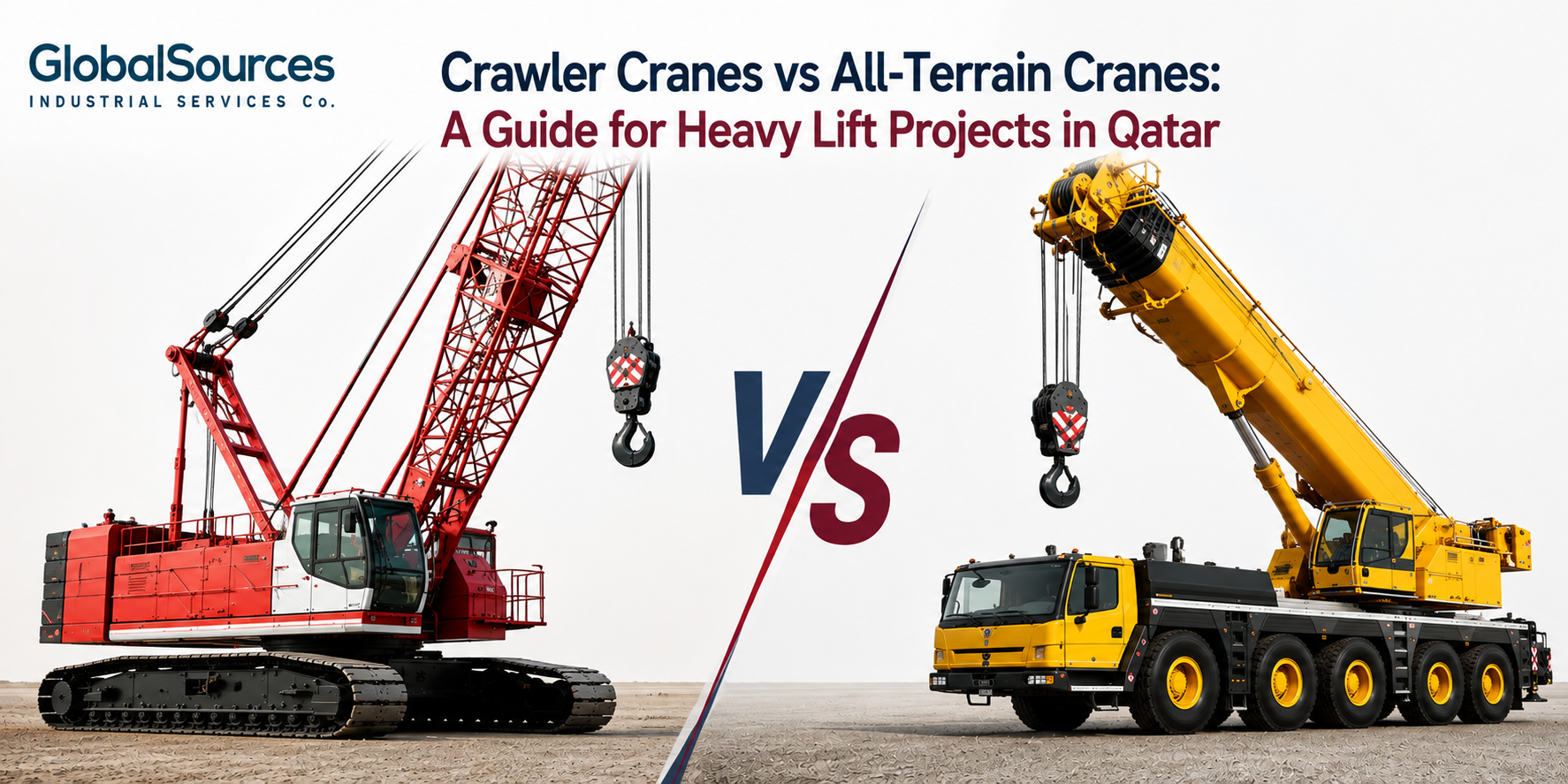
For most general construction lifts in Qatar, an all-terrain crane is the go-to solution. But for the heaviest lifts — LNG plant turnarounds, refinery module installation, and long-duration heavy lifts at Ras Laffan or Mesaieed — a crawler crane is often the only practical choice.
Understanding when a crawler crane makes more sense than an AT crane can save significant cost and planning time on your next major project.
“Crawler cranes don’t travel fast, but they lift heavy and stand firm. For the biggest lifts in Qatar, nothing else comes close.”
What Is a Crawler Crane?
A crawler crane is a lifting machine mounted on two sets of continuous tracks — like a tank — rather than tyres. The tracks distribute the crane’s weight over a very large footprint, allowing it to work on soft or variable ground without outriggers. Crawler cranes are capable of lifting and travelling with a load suspended — something no wheeled crane can safely do. Capacities range from 100 tons to over 3,500 tons for the largest lattice boom crawlers.
Key Differences: Crawler vs All-Terrain
Factor
Crawler Crane
All-Terrain Crane
Capacity Range
100T – 3,500T+
50T – 1,200T
Ground Bearing
Low — spreads weight over tracks
High — requires solid ground or mats
Mobility
Cannot travel on roads — requires transport
Self-propelled on roads
Mobilisation
Complex — disassembled for transport
Simple — drives to site
Set-Up Time
Hours to days
30–60 minutes
Duration
Best for long-term site stays
Best for single or short lifts
Load & Carry
Can travel with load suspended
Cannot
Qatar Use
LNG plants, refineries, mega projects
General construction, oil & gas
When to Choose a Crawler Crane in Qatar
Choose a crawler crane when your lift exceeds the capacity of available AT cranes, when you need to work on soft or variable ground, when the lift will take multiple days and the crane needs to remain in position, or when the project involves load-and-carry operations — moving a load while the crane is in motion.
In Qatar, crawler cranes are most commonly deployed at Ras Laffan Industrial City for LNG plant turnarounds, module lifts, and maintenance of QatarEnergy facilities; at Mesaieed for refinery and petrochemical projects; and on large infrastructure projects such as bridges and marine structures.
BUDGETNOTE: The biggest cost factor with crawler cranes in Qatar is mobilisation. Disassembling, transporting, and reassembling a large crawler crane typically takes 2–5 days. Build this into your project schedule and budget before committing.
Global Sources Qatar provides crawler cranes from 100T to 700T with certified operators for heavy lift projects at Ras Laffan, Mesaieed, and major Qatar infrastructure sites.
Every crane has a headline capacity — 50 ton, 100 ton, 220 ton. But these numbers are frequently misunderstood by project managers, and that misunderstanding leads to dangerous undersizing or unnecessary overspend on rental.
This guide explains what crane capacity actually means, why the lift radius changes everything, and how to select the right crane tonnage for your Qatar project.
“A 100-ton crane can lift 100 tons — but only at the right radius. At 20 metres, it might only lift 30.”
What Does Crane Capacity Mean?
A crane’s rated capacity is the maximum load it can safely lift under ideal conditions — typically at the shortest possible radius (directly below the hook) and with the boom at its optimal angle. As the radius increases, the capacity drops significantly. This is governed by the crane’s load chart — a table or curve provided by the manufacturer showing safe lifting capacity at every combination of radius and boom length.
CRITICAL: Always request the load chart from your crane rental provider before confirming your booking. Without it, you cannot verify that the crane can safely perform your lift at your required radius.
How Radius Affects Capacity — A Practical Example
Crane Rating
At 5m Radius
At 10m Radius
At 15m Radius
At 20m Radius
50 Ton AT Crane
50T
32T
22T
15T
100 Ton AT Crane
100T
68T
42T
28T
220 Ton AT Crane
220T
140T
90T
58T
These figures are approximate and vary by crane model. The point is clear: the further the load is from the crane, the less it can safely lift. Always calculate your required lift capacity at your actual radius — not the headline tonnage.
Crane Capacity Selection Guide for Qatar Projects
Load Weight
Required Radius
Minimum Crane Size to Consider
Up to 10T
Up to 15m
25–30 ton mobile crane
10T – 25T
Up to 20m
50 ton all-terrain crane
25T – 50T
Up to 20m
100 ton all-terrain crane
50T – 100T
Up to 25m
220 ton all-terrain crane
Over 100T
Any
Crawler crane — consult lift engineer
Four Numbers You Must Have Before Booking
1
Load weight
The exact weight of the item being lifted, including all rigging and below-the-hook equipment.
2
Lift radius
The horizontal distance from the crane centre pin to the centre of the load at the pick-up and set-down points.
3
Required lift height
How high does the load need to travel? This determines boom length and configuration.
4
Headroom and obstructions
Are there overhead power lines, structures, or other cranes in the swing path?
Global Sources Qatar’s lifting team will review your load details and recommend the correct crane capacity for your project. Fleet ranges from 25T to 700T across Qatar.
QatarEnergy is Qatar’s national oil and gas company — and one of the largest energy companies in the world. Its projects at Ras Laffan, the North Field LNG expansion, and across Qatar’s industrial cities set some of the most demanding equipment and contractor standards in the region.
For contractors and sub-contractors working within QatarEnergy project environments, understanding the specific heavy equipment rental requirements before mobilisation is critical to avoiding costly compliance failures.
“QatarEnergy’s safety standards are among the strictest in the world. Equipment that passes a general construction site check will not always pass a QatarEnergy site check.”
QatarEnergy Equipment Standards — The Basics
All equipment deployed on QatarEnergy projects must meet QatarEnergy’s own technical standards, which incorporate international codes including API, ASME, ISO, and NFPA. For lifting equipment, this means current third-party inspection certificates, load test records, and operator certification to a recognised international standard. For generators and electrical equipment, earthing certificates and electrical inspection records are mandatory.
Key Documentation Required
✔ Third-party inspection certificate
Current, valid, and issued by a QCDD-recognised body
✔ Load test certificate
For all lifting equipment — not older than 12 months
✔ Operator certification
LEEA and/or OPITO as specified in the project requirements
✔ Qatar Civil Defence operator card
Mandatory for all crane and heavy equipment operators
✔ Colour coding compliance
QatarEnergy uses a quarterly colour-coding system for inspected equipment — all equipment must display the current quarter colour
✔ Equipment registration Some QatarEnergy projects require pre-registration of all major equipment before
mobilisation
The QatarEnergy Colour Coding System
QatarEnergy and many Qatar oil and gas projects operate a colour-coding inspection system where all lifting equipment, tools, and electrical equipment must display a coloured tag indicating the quarter in which it was last inspected. Equipment displaying an outdated colour tag will be rejected at the gate.
The colours rotate quarterly. Before mobilising any equipment to a QatarEnergy project, confirm with your site contact which colour is current for that quarter and ensure your rental provider’s equipment carries the correct tag.
IMPORTANT: Always confirm the current inspection colour code with your QatarEnergy site contact before mobilisation. Equipment rejected at the gate means a full-day delay minimum.
Approved Vendor Requirements
For direct contracts with QatarEnergy, equipment suppliers may need to be pre-qualified on QatarEnergy’s vendor database. However, for sub-contractor and contractor-supplied equipment, the main contractor typically takes responsibility for ensuring equipment compliance. If you are a sub-contractor, confirm with your main contractor which equipment supplier approvals are required before sourcing your rental.
Global Sources Qatar has extensive experience supplying equipment to QatarEnergy project environments. All equipment carries current colour-coded inspection tags and full compliance documentation.
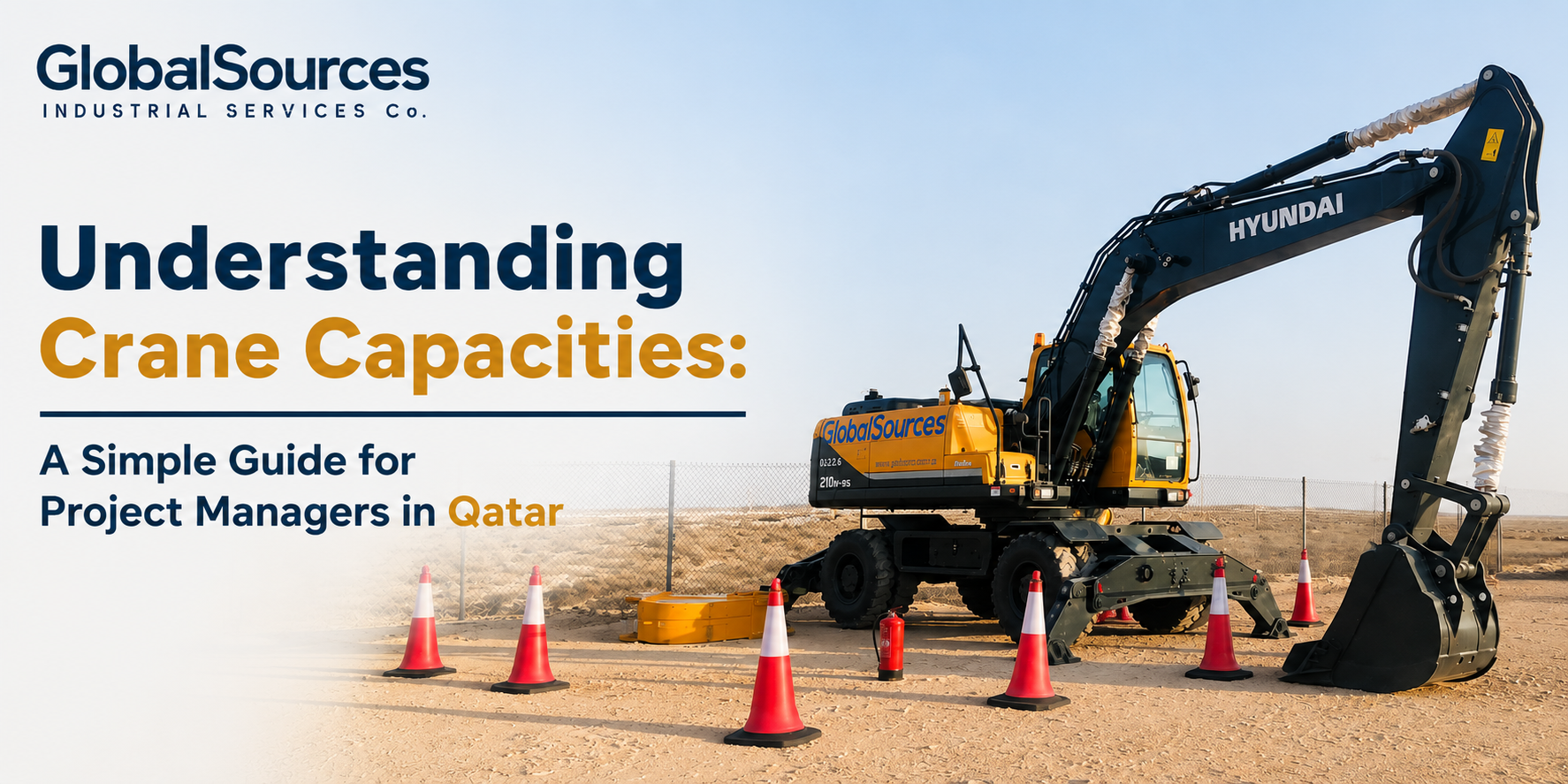
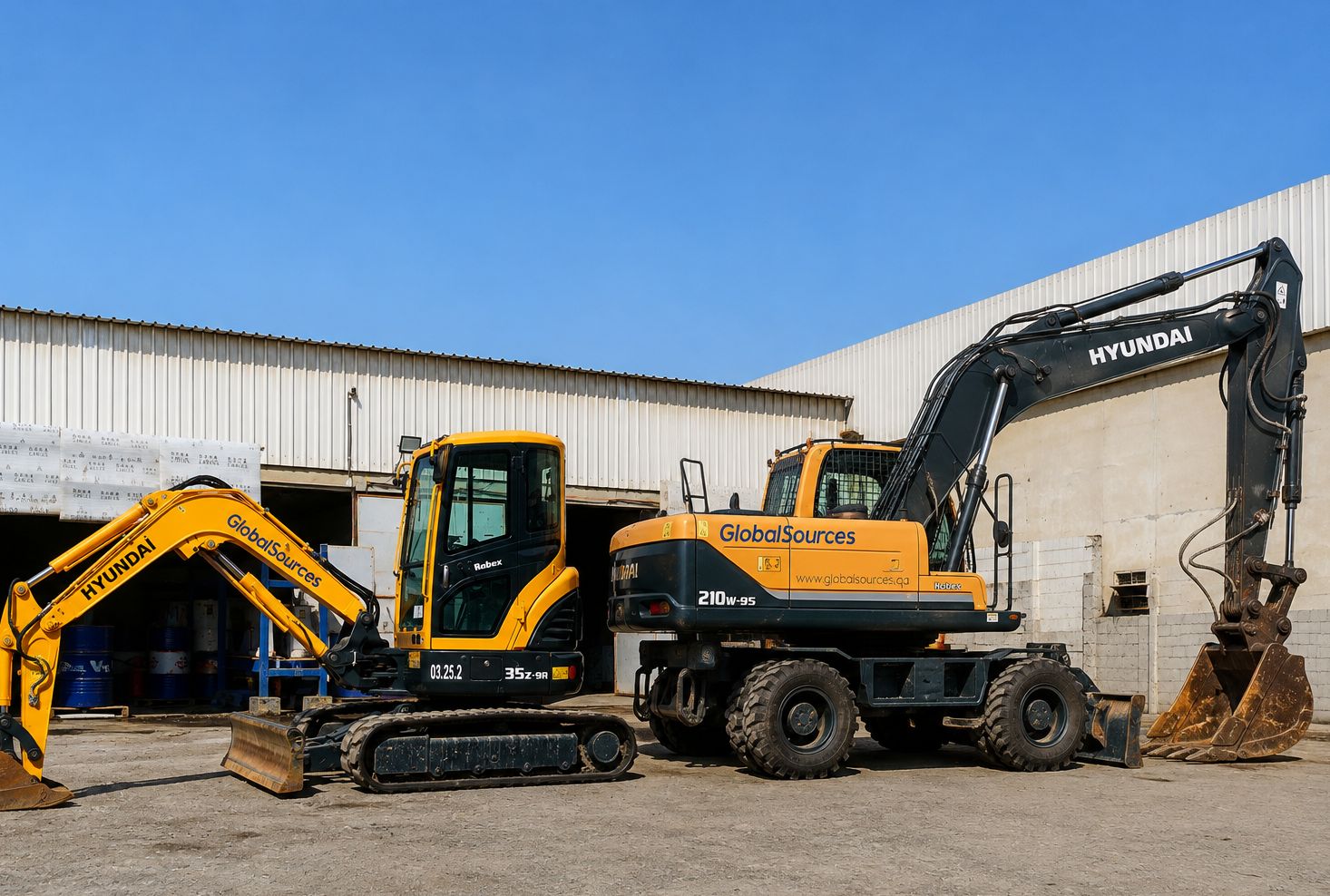
Excavators come in a wide range of sizes — from 1-ton mini machines that fit through a standard doorway to 50-ton heavy excavators that move mountains of material. Choosing the right size for your Qatar project directly affects your productivity, your cost, and in some cases your site safety.
This guide covers the main excavator size categories, what each is best suited for, and how to make the right selection for your specific Qatar site conditions.
“A bigger excavator is not always a better excavator. The right size is the one that fits your trench width, your site access, and your output target.”
Standard foundation and civil works, pipeline, most Qatar construction projects
Large
30T – 50T+
Up to 9m+
Heavy earthworks, deep basements, major infrastructure, oil & gas civil works
The Most Common Excavator Size in Qatar
The 14T–25T medium excavator is by far the most commonly rented excavator size on Qatar construction projects. It handles the majority of foundation, drainage, and civil works tasks efficiently, fits through standard site access gates, and is available from most equipment rental providers.
For projects with narrow trenches or confined site access in Doha’s urban areas, the 6T–10T small excavator is often the right choice despite lower output — because it can physically access areas a medium machine cannot reach.
What to Tell Your Rental Provider
✔ Required dig depth
The maximum depth your trench or foundation requires determines minimum bucket arm reach
✔ Site access width
Gate width and access route determines maximum machine width
✔ Material type
Sand and light soil vs rock or concrete debris affects bucket and machine size selection
✔ Daily output target
Cubic metres of material to move per day helps determine machine size and number required
✔ Ground bearing capacity
Soft ground may require a machine with lower ground pressure (wider tracks or smaller machine)
GROUNDNOTE: Qatar’s sandy soil is generally easy to excavate. But in some areas — particularly near the coast and in older industrial zones — you may encounter rock or contaminated ground that requires specialist buckets or larger machines. Confirm ground conditions before selecting your excavator size.
Global Sources Qatar provides excavators from 1T mini to 50T heavy, with certified operators, across Doha, Ras Laffan, Lusail, Mesaieed, and all Qatar project locations.
All-terrain cranes and mobile cranes are the two most commonly rented crane types in Qatar. Both are wheeled, both are self-propelled, and both can handle a wide range of lifts. But they are different machines designed for different conditions — and choosing the wrong one will cost you.
This guide explains the key differences and helps you decide which type is right for your Qatar project.
“All-terrain cranes go everywhere. Mobile cranes go fast. The question is which one your site actually needs.”
All-Terrain Cranes — What They Are and When to Use Them
All-terrain cranes (AT cranes) are designed to travel on both public highways and rough, unpaved terrain. They have multi-axle all-wheel-drive and all-wheel-steer systems that allow them to manoeuvre in tight spaces and on uneven ground. In Qatar, AT cranes are the most commonly rented crane type — used on construction sites, oil and gas facilities, infrastructure projects, and anywhere that requires both road travel and off-road access.
Popular AT crane brands in Qatar include Liebherr LTM, Grove GMK, and Tadano ATF series, available in capacities from 50 tons to 500 tons.
Mobile Cranes — What They Are and When to Use Them
Mobile cranes — sometimes called truck cranes or hydraulic truck cranes — are mounted on a standard truck carrier. They travel on public roads at normal highway speeds and set up quickly at site. They are ideal for projects where fast mobilisation and frequent repositioning are priorities. Mobile cranes are widely used in Qatar for construction, maintenance, and equipment installation where the site has good road access and relatively flat ground.
Direct Comparison
Feature
All-Terrain Crane
Mobile Crane
Road Travel Speed
Up to 80 km/h
Up to 80 km/h
Off-Road Capability
Excellent — all-wheel drive
Limited — road surfaces only
Capacity Range
50T – 1,200T
25T – 220T
Set-Up Time
30–60 minutes
15–30 minutes
Best For
Oil & gas, rough terrain, large lifts
Fast mobilisation, frequent moves
Qatar Usage
Ras Laffan, Mesaieed, large construction
General Doha construction, maintenance
RECOMMENDATION
For most large construction and oil & gas projects in Qatar, an all-terrain crane is the safer and more versatile choice. If your priority is speed and your site has good road access, a mobile crane will be faster to mobilise and set up.
Which One Is Right for Your Project?
Choose an all-terrain crane if: your site has unpaved or uneven ground, you are working at Ras Laffan or Mesaieed, you need a capacity over 100 tons, or your lift will involve long durations.
Choose a mobile crane if: your site has good road access, you need fast mobilisation, you are doing frequent repositioning lifts, or your lift is under 100 tons on a flat prepared surface.
Global Sources Qatar operates Liebherr, Grove, and Tadano all-terrain cranes and mobile cranes with certified operators across all Qatar project locations.
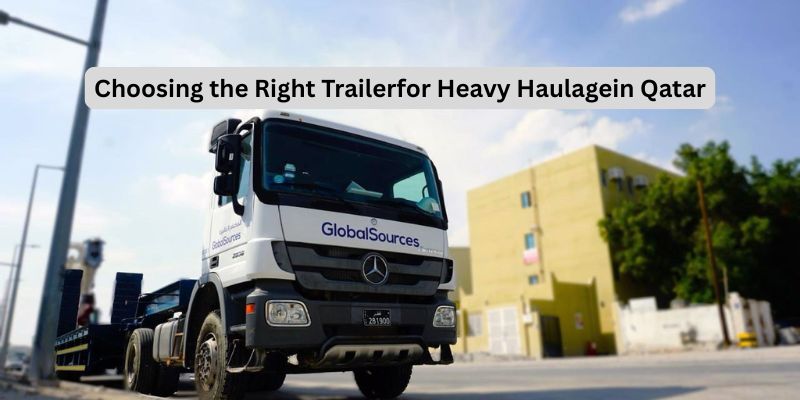
Qatar’s construction and industrial sectors move enormous volumes of equipment and materials between sites every day. The trailer you choose determines whether that movement is safe, legal, and cost-effective — or whether it creates permit problems, load damage, and project delays.
This guide covers the main heavy haulage trailer types used in Qatar, what each one is designed for, and how to select the right one for your specific load.
“The wrong trailer is not just inefficient — it can be illegal, unsafe, and a significant liability on Qatar’s public roads.”
Trailer Types and Their Load Profiles
Trailer Type
Payload Range
Height Profile
Best Load Types in Qatar
Standard Flatbed
Up to 40T
Standard deck (~1.2m)
Steel, pipes, construction materials, palletised goods
Step-Deck / Semi Low Bed
Up to 60T
Lower deck (~0.8m)
Medium-height equipment, industrial units, construction machinery
Low Bed
Up to 100T
Very low deck (~0.4m)
Excavators, bulldozers, cranes, tall heavy machinery
Extendable Low Bed
Up to 100T
Very low deck
Long loads — bridge beams, wind turbine components, long structures
Multi-Axle Trailer
100T – 250T
Low bed with many axles
Very heavy loads — large plant equipment, oil & gas modules
SPMT
Unlimited
Hydraulic adjustable
Largest industrial moves — see SPMT guide
Key Selection Factors
✔ Total load weight Including the machine plus any attachments, rigging, and securing equipment
✔ Load height
The finished height on the trailer must stay within Qatar’s 4.3m road limit
✔ Load length
Loads over 20m typically require a permit and possibly an escort vehicle
✔ Load width
Loads over 2.5m wide require a movement permit. Over 5m may need police escort
✔ Axle weight distribution
Confirm each axle group stays within Qatar’s road axle load limits
Permit Requirements in Qatar
Qatar’s Ministry of Interior regulates all abnormal loads on public roads. Any load that exceeds 48 tons gross vehicle weight, 2.5m width, 4.3m height, or 20m length requires a road movement permit before travel. The permit process involves route survey, load drawings, and in some cases structural assessment of bridges on the route.
For loads to Ras Laffan Industrial City or Mesaieed Industrial City, additional approvals from the industrial city authority are required at the gate. Your transport provider should be familiar with both the road permit process and the specific industrial city access requirements.
PLANNING: Build permit lead time into your project schedule. Standard abnormal load permits in Qatar typically take 3–5 working days. Complex routes with bridge assessments or escort requirements can take longer.
Global Sources Qatar provides flatbed, low bed, multi-axle trailers and SPMT with full permit management and experienced drivers across Qatar.