globalsources

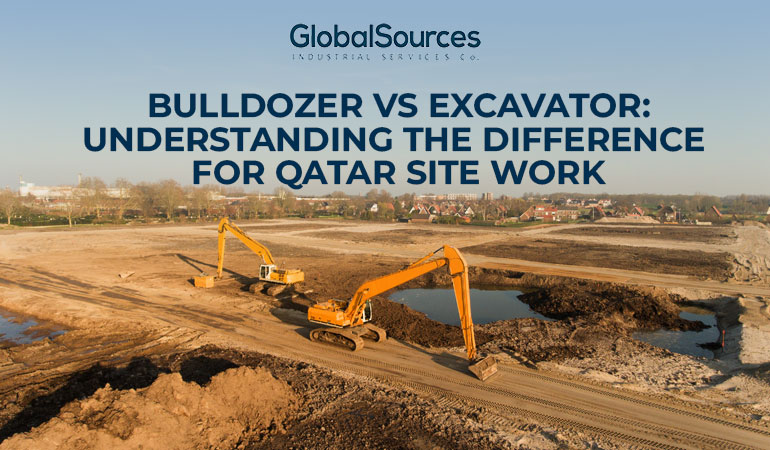
Bulldozer vs Excavator: Understanding the Difference for Qatar Site Work

Bulldozers and excavators are the two most visible machines on large Qatar construction sites. To an untrained eye they both move dirt. But they do it in completely different ways — and for completely different purposes. Using one when you need the other costs time and money.

This guide explains what each machine does, when to use which, and when you need both working together.

“The bulldozer moves the ground. The excavator digs it. Most large Qatar sites need both — the question is in what sequence.”

What a Bulldozer Does Best

A bulldozer excels at bulk material pushing. Its fixed front blade can push massive volumes of soil, sand, rock, and debris across a site at high speed. It is the right machine for initial site clearing — stripping vegetation, removing surface material, pushing stockpiles, and rough-grading large areas. Bulldozers work fast over large areas but they cannot dig deep holes, load material into trucks, or work in confined spaces.

In Qatar, bulldozers are commonly seen on large site clearance operations ahead of foundation works — at Lusail development sites, infrastructure corridors, and industrial zone preparation at Ras Laffan and Mesaieed.

What an Excavator Does Best

An excavator digs. Its rotating upper body and articulated boom can reach below ground level, dig precise trenches, load material into trucks, and work in a fixed position over a sustained period. It is the right machine for foundation excavation, drainage trenching, pipeline installation, and material loading. Excavators are not suited for bulk pushing or large-area grading.


Direct Comparison

Task Bulldozer Excavator
Large-area site clearing ■ Best choice ■ Too slow
Foundation digging ■ Cannot dig precisely ■ Best choice
Trench excavation ■ Wrong machine ■ Best choice
Loading dump trucks ■ Cannot load trucks ■ Best choice
Rough grading (large area) ■ Best choice ■ Too slow
Backfilling trenches ■ Good choice ■ Also effective
Working in confined spaces ■ Too large ■ Mini or medium excavator


When You Need Both

On large Qatar construction projects — major infrastructure, industrial site development, and large residential schemes — a bulldozer and excavator typically work together. The bulldozer clears and rough-grades the site first. The excavator then follows to dig foundations, trenches, and drainage. Both are essential, but they work in sequence rather than simultaneously on the same task.

SEQUENCING Sequence matters. Mobilise the bulldozer first for site clearing, then bring in excavators for foundation and trench work. Running both simultaneously on the same area creates interference and reduces output from both machines.
Global Sources Qatar provides bulldozers, excavators, and full earthmoving fleets with operators across Qatar construction and industrial projects.
View our full services: globalsources.qa/earth-moving

How to Become an Approved Equipment Vendor for Oil & Gas Projects in Qatar

Qatar’s oil and gas sector is one of the most active in the world — and one of the most demanding when it comes to supplier qualification. For heavy equipment rental and supply companies that want to work with QatarEnergy, Ras Laffan operators, and major EPC contractors in Qatar, the pre-qualification and vendor registration process is a critical first step.

This guide covers the key requirements for becoming a recognised equipment vendor in Qatar’s oil and gas sector.

“In Qatar’s oil and gas sector, getting on the approved vendor list is the work done before the work begins.”

Why Vendor Pre-Qualification Matters

Major oil and gas operators in Qatar — QatarEnergy and its subsidiaries — require all suppliers of goods and services to be pre-qualified on their vendor database before they can be awarded contracts or purchase orders. This process verifies the company’s financial standing, technical capability, HSE track record, and legal compliance. Without pre-qualification, your company cannot bid on or receive direct awards from these operators.

The QatarEnergy Vendor Registration Process


1 Initial Application

Submit company details, trade licence, and basic financial information through QatarEnergy’s supplier portal.


2

Technical Pre-Qualification

Provide equipment lists, fleet details, certifications, and technical capability documentation relevant to your supply category.


3

HSE Assessment

Complete QatarEnergy’s HSE pre-qualification questionnaire covering safety record, incident history, management systems, and training.

4 Financial Assessment

Submit audited financial statements. QatarEnergy requires evidence of financial stability before approving suppliers.


Site Assessment (if required)

5      For larger contracts, QatarEnergy may conduct a physical audit of your facilities, fleet, and operations.

Approval and Listing

6      Once approved, your company is listed on the QatarEnergy vendor database and can be included on tender invitations.

Key Requirements for Equipment Suppliers


✔ Valid Qatar Commercial Registration (CR) All suppliers must hold a valid Qatar CR in the relevant business activity
✔ ISO 9001 Certification Quality management system certification — widely required
✔ ISO 45001 or OHSAS 18001 Occupational health and safety management certification
✔ Fleet documentation Comprehensive equipment list with inspection records for all major items
✔ Qualified personnel CVs, certifications, and competency records for key technical staff
✔ HSE statistics 3-year safety record including lost time injury frequency rate
TIMING: The QatarEnergy pre-qualification process typically takes 3–6 months. Begin the process well in advance of when you need to be active. Many equipment suppliers lose business because they started the registration process too late.


Global Sources Qatar is an experienced equipment supplier in Qatar’s oil and gas sector, serving QatarEnergy project environments at Ras Laffan and Mesaieed.
View our full services: globalsources.qa/heavy-Equipment

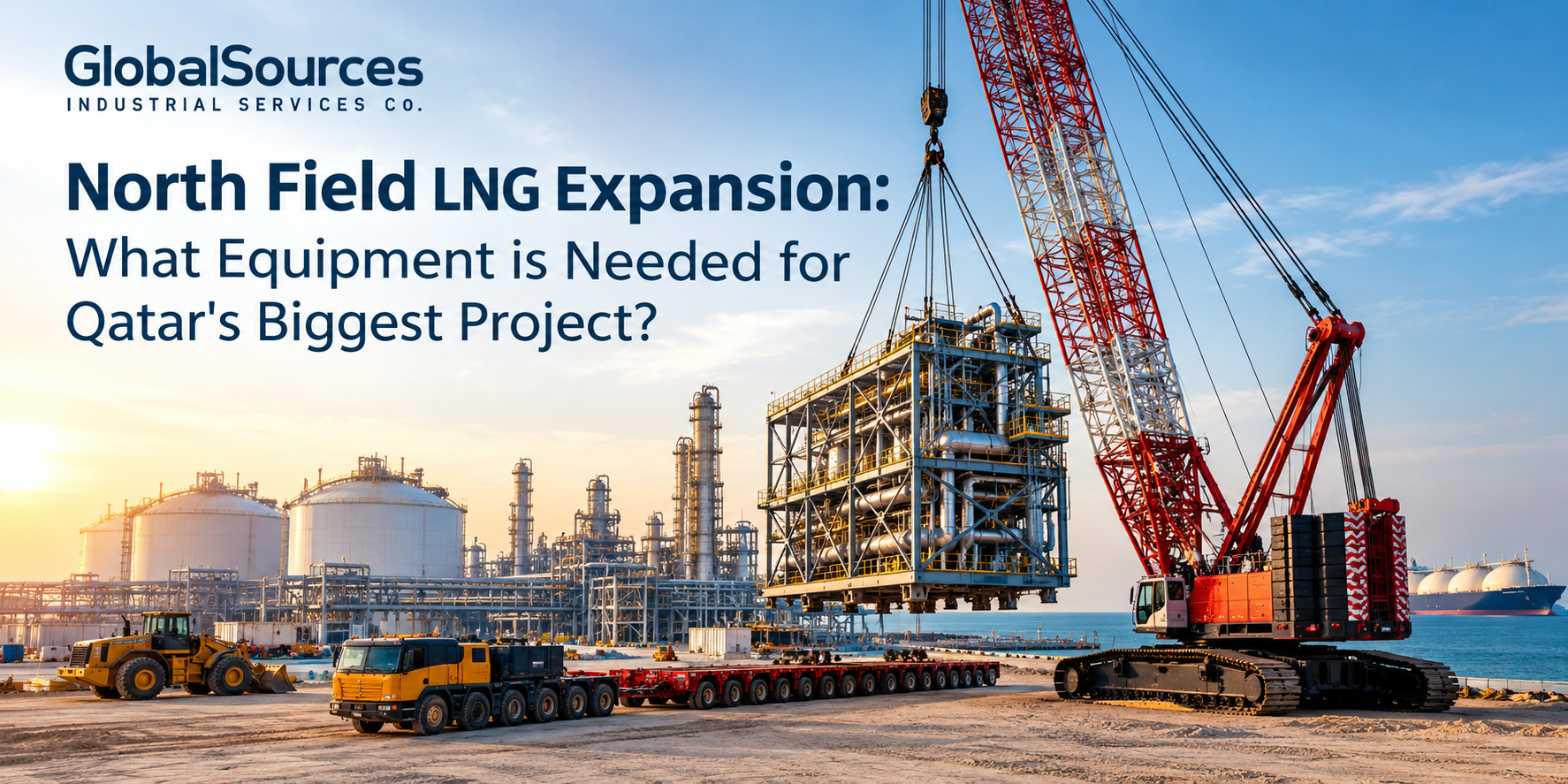
North Field LNG Expansion: What Equipment is Needed for Qatar’s Biggest Project?

Qatar’s North Field LNG expansion is one of the largest energy projects in the world. Adding over 48 million tons per year of LNG capacity by the late 2020s, the project involves enormous construction activity across Qatar — creating sustained, long-term demand for heavy equipment across every category.

For contractors involved in North Field packages and for equipment rental companies serving the sector, understanding the scale and nature of equipment requirements on this project is essential.

“The North Field expansion is not one project — it is dozens of parallel projects, all demanding equipment at the same time. Planning and early commitment are everything.”

Scale of the North Field Expansion

The North Field expansion encompasses six new LNG trains — North Field East (NFE), North Field South (NFS), and further phases — each requiring enormous construction activity including civil works, structural steel, mechanical installation, and commissioning. The project centres on Ras Laffan Industrial City with supporting infrastructure extending to Al Khor, Mesaieed, and marine facilities along the coast.

Key Equipment Categories in High Demand


Equipment Category Why It’s Needed Demand Level
Heavy Cranes (100T–700T+) Module installation, pressure vessel placement, structural steel erection Extremely High
Crawler Cranes Long-duration heavy lifts at process facilities Very High
Excavators (20T–50T) Civil works, foundations, drainage, pipeline trenching Very High
Generators (500kVA+) Temporary power for construction camps, tool power, commissioning High
Low Bed Trailers Transporting heavy modules and equipment to Ras Laffan High
SPMT Moving oversized modules within the plant High


Dewatering Pumps Foundation works, trench dewatering Medium–High
Forklifts & Telehandlers Material handling across large site areas High

What Contractors Need to Prepare For

The North Field expansion creates a tightening of equipment availability across Qatar. With multiple large EPC contractors operating simultaneously, crane and heavy equipment availability at short notice becomes increasingly difficult. Contractors involved in North Field packages should plan equipment requirements 3–6 months in advance and secure long-term rental agreements early.

Equipment compliance for North Field packages follows QatarEnergy’s full technical standards — colour-coded inspection tags, OPITO-certified operators for lifting operations, ATEX equipment in classified areas, and full PTW compliance across all activities.

PLANNING: For North Field work, do not assume equipment will be available at short notice. Secure your crane and heavy equipment rental commitments as part of your project mobilisation plan — ideally 3 months before your first lift.


Global Sources Qatar supplies cranes, excavators, generators, trailers, and dewatering solutions for major Qatar energy projects including North Field-related work at Ras Laffan.
View our full services: globalsources.qa/heavy-Equipment

Working at Ras Laffan Industrial City: Equipment and Safety Requirements

Ras Laffan Industrial City is one of the largest LNG and petrochemical complexes in the world — and one of the most strictly managed industrial environments in Qatar. For contractors and equipment suppliers entering RLIC for the first time, the access and compliance requirements can seem overwhelming.

This guide covers the key equipment and safety requirements that apply at Ras Laffan, drawn from the experience of working regularly in this environment.

“Ras Laffan is not a standard construction site. The safety standards are world-class because the consequences of getting it wrong are serious.”

Gate Access — What You Need to Enter


✔ Vehicle gate pass                         All vehicles require a pre-approved gate pass. Arrange through your main contractor or QatarEnergy project coordinator minimum 48 hours in advance.
✔ Driver QatarEnergy                       All drivers entering RLIC must hold a valid QatarEnergy contractor identification card.

contractor card

✔ Vehicle inspection at gate          Vehicles are inspected at the gate — tyres, load securing, lighting, and documentation.

Substandard vehicles are turned away.

✔ Load documentation                   All cargo and equipment must have a packing list or delivery note matching what is

presented at the gate.

Equipment Certification Requirements


Equipment Type Certification Required Additional RLIC Requirement
Cranes & lifting equipment Third-party inspection + load test cert Current QatarEnergy colour tag
Generators & electrical Electrical inspection certificate Earthing certificate before energising
Pressure equipment Design certification + pressure test record Relevant API/ASME standard compliance
Vehicles Standard Qatar traffic registration Valid RLIC gate pass + driver contractor card


Tools & equipment General maintenance record Quarterly colour tag inspection system

Hazardous Area — ATEX Requirements

Parts of Ras Laffan are classified as hazardous areas — zones where flammable gas or vapour may be present. Any equipment operating in or near these zones must be ATEX-rated (or equivalent) to prevent ignition sources. Standard diesel generators, non-ATEX electrical equipment, and standard vehicles cannot enter classified zones.

Always confirm with your site contact whether your work location is within a classified hazardous zone before mobilising equipment. This determines whether standard or ATEX-rated equipment is required.

SAFETY: When in doubt, ask your QatarEnergy project coordinator for the hazardous area drawing for your work location before selecting equipment. Deploying non-ATEX equipment in a classified zone is a serious safety violation.

Permit to Work at Ras Laffan

All work at Ras Laffan Industrial City requires a valid permit to work (PTW) before any activity begins. The PTW system covers hot work, cold work, lifting operations, confined space entry, and electrical isolation. Equipment operators must be briefed on the PTW requirements and must not begin any work until the permit is signed and in place. All equipment suppliers working at RLIC should ensure their operators are familiar with the RLIC PTW process.

Global Sources Qatar operates regularly within Ras Laffan Industrial City. Our equipment carries full RLIC-compliant documentation and our operators hold QatarEnergy contractor cards.
View our full services: globalsources.qa/heavy-Equipment
Best Industrial Service Provider in Qatar - Global Sources Doha

Do You Want To Talk With Us? So Don't be Late.

Call Us: +974 4468 5501