Qatar’s oil and gas sector is one of the most active in the world — and one of the most demanding when it comes to supplier qualification. For heavy equipment rental and supply companies that want to work with QatarEnergy, Ras Laffan operators, and major EPC contractors in Qatar, the pre-qualification and vendor registration process is a critical first step.
This guide covers the key requirements for becoming a recognised equipment vendor in Qatar’s oil and gas sector.
“In Qatar’s oil and gas sector, getting on the approved vendor list is the work done before the work begins.”
Why Vendor Pre-Qualification Matters
Major oil and gas operators in Qatar — QatarEnergy and its subsidiaries — require all suppliers of goods and services to be pre-qualified on their vendor database before they can be awarded contracts or purchase orders. This process verifies the company’s financial standing, technical capability, HSE track record, and legal compliance. Without pre-qualification, your company cannot bid on or receive direct awards from these operators.
The QatarEnergy Vendor Registration Process
1
Initial Application
Submit company details, trade licence, and basic financial information through QatarEnergy’s supplier portal.
2
Technical Pre-Qualification
Provide equipment lists, fleet details, certifications, and technical capability documentation relevant to your supply category.
Submit audited financial statements. QatarEnergy requires evidence of financial stability before approving suppliers.
Site Assessment (if required)
5For larger contracts, QatarEnergy may conduct a physical audit of your facilities, fleet, and operations.
Approval and Listing
6Once approved, your company is listed on the QatarEnergy vendor database and can be included on tender invitations.
Key Requirements for Equipment Suppliers
✔ Valid Qatar Commercial Registration (CR)
All suppliers must hold a valid Qatar CR in the relevant business activity
✔ ISO 9001 Certification
Quality management system certification — widely required
✔ ISO 45001 or OHSAS 18001
Occupational health and safety management certification
✔ Fleet documentation
Comprehensive equipment list with inspection records for all major items
✔ Qualified personnel
CVs, certifications, and competency records for key technical staff
✔ HSE statistics
3-year safety record including lost time injury frequency rate
TIMING: The QatarEnergy pre-qualification process typically takes 3–6 months. Begin the process well in advance of when you need to be active. Many equipment suppliers lose business because they started the registration process too late.
Global Sources Qatar is an experienced equipment supplier in Qatar’s oil and gas sector, serving QatarEnergy project environments at Ras Laffan and Mesaieed.
View our full services: globalsources.qa/heavy-Equipment
Qatar’s North Field LNG expansion is one of the largest energy projects in the world. Adding over 48 million tons per year of LNG capacity by the late 2020s, the project involves enormous construction activity across Qatar — creating sustained, long-term demand for heavy equipment across every category.
For contractors involved in North Field packages and for equipment rental companies serving the sector, understanding the scale and nature of equipment requirements on this project is essential.
“The North Field expansion is not one project — it is dozens of parallel projects, all demanding equipment at the same time. Planning and early commitment are everything.”
Scale of the North Field Expansion
The North Field expansion encompasses six new LNG trains — North Field East (NFE), North Field South (NFS), and further phases — each requiring enormous construction activity including civil works, structural steel, mechanical installation, and commissioning. The project centres on Ras Laffan Industrial City with supporting infrastructure extending to Al Khor, Mesaieed, and marine facilities along the coast.
Temporary power for construction camps, tool power, commissioning
High
Low Bed Trailers
Transporting heavy modules and equipment to Ras Laffan
High
SPMT
Moving oversized modules within the plant
High
Dewatering Pumps
Foundation works, trench dewatering
Medium–High
Forklifts & Telehandlers
Material handling across large site areas
High
What Contractors Need to Prepare For
The North Field expansion creates a tightening of equipment availability across Qatar. With multiple large EPC contractors operating simultaneously, crane and heavy equipment availability at short notice becomes increasingly difficult. Contractors involved in North Field packages should plan equipment requirements 3–6 months in advance and secure long-term rental agreements early.
Equipment compliance for North Field packages follows QatarEnergy’s full technical standards — colour-coded inspection tags, OPITO-certified operators for lifting operations, ATEX equipment in classified areas, and full PTW compliance across all activities.
PLANNING: For North Field work, do not assume equipment will be available at short notice. Secure your crane and heavy equipment rental commitments as part of your project mobilisation plan — ideally 3 months before your first lift.
Global Sources Qatar supplies cranes, excavators, generators, trailers, and dewatering solutions for major Qatar energy projects including North Field-related work at Ras Laffan.
View our full services: globalsources.qa/heavy-Equipment
Ras Laffan Industrial City is one of the largest LNG and petrochemical complexes in the world — and one of the most strictly managed industrial environments in Qatar. For contractors and equipment suppliers entering RLIC for the first time, the access and compliance requirements can seem overwhelming.
This guide covers the key equipment and safety requirements that apply at Ras Laffan, drawn from the experience of working regularly in this environment.
“Ras Laffan is not a standard construction site. The safety standards are world-class because the consequences of getting it wrong are serious.”
Gate Access — What You Need to Enter
✔ Vehicle gate pass All vehicles require a pre-approved gate pass. Arrange through your main contractor or QatarEnergy project coordinator minimum 48 hours in advance.
✔ Driver QatarEnergy All drivers entering RLIC must hold a valid QatarEnergy contractor identification card.
contractor card
✔ Vehicle inspection at gate Vehicles are inspected at the gate — tyres, load securing, lighting, and documentation.
Substandard vehicles are turned away.
✔ Load documentation All cargo and equipment must have a packing list or delivery note matching what is
presented at the gate.
Equipment Certification Requirements
Equipment Type
Certification Required
Additional RLIC Requirement
Cranes & lifting equipment
Third-party inspection + load test cert
Current QatarEnergy colour tag
Generators & electrical
Electrical inspection certificate
Earthing certificate before energising
Pressure equipment
Design certification + pressure test record
Relevant API/ASME standard compliance
Vehicles
Standard Qatar traffic registration
Valid RLIC gate pass + driver contractor card
Tools & equipment
General maintenance record
Quarterly colour tag inspection system
Hazardous Area — ATEX Requirements
Parts of Ras Laffan are classified as hazardous areas — zones where flammable gas or vapour may be present. Any equipment operating in or near these zones must be ATEX-rated (or equivalent) to prevent ignition sources. Standard diesel generators, non-ATEX electrical equipment, and standard vehicles cannot enter classified zones.
Always confirm with your site contact whether your work location is within a classified hazardous zone before mobilising equipment. This determines whether standard or ATEX-rated equipment is required.
SAFETY: When in doubt, ask your QatarEnergy project coordinator for the hazardous area drawing for your work location before selecting equipment. Deploying non-ATEX equipment in a classified zone is a serious safety violation.
Permit to Work at Ras Laffan
All work at Ras Laffan Industrial City requires a valid permit to work (PTW) before any activity begins. The PTW system covers hot work, cold work, lifting operations, confined space entry, and electrical isolation. Equipment operators must be briefed on the PTW requirements and must not begin any work until the permit is signed and in place. All equipment suppliers working at RLIC should ensure their operators are familiar with the RLIC PTW process.
Global Sources Qatar operates regularly within Ras Laffan Industrial City. Our equipment carries full RLIC-compliant documentation and our operators hold QatarEnergy contractor cards.
View our full services: globalsources.qa/heavy-Equipment
QatarEnergy is Qatar’s national oil and gas company — and one of the largest energy companies in the world. Its projects at Ras Laffan, the North Field LNG expansion, and across Qatar’s industrial cities set some of the most demanding equipment and contractor standards in the region.
For contractors and sub-contractors working within QatarEnergy project environments, understanding the specific heavy equipment rental requirements before mobilisation is critical to avoiding costly compliance failures.
“QatarEnergy’s safety standards are among the strictest in the world. Equipment that passes a general construction site check will not always pass a QatarEnergy site check.”
QatarEnergy Equipment Standards — The Basics
All equipment deployed on QatarEnergy projects must meet QatarEnergy’s own technical standards, which incorporate international codes including API, ASME, ISO, and NFPA. For lifting equipment, this means current third-party inspection certificates, load test records, and operator certification to a recognised international standard. For generators and electrical equipment, earthing certificates and electrical inspection records are mandatory.
Key Documentation Required
✔ Third-party inspection certificate
Current, valid, and issued by a QCDD-recognised body
✔ Load test certificate
For all lifting equipment — not older than 12 months
✔ Operator certification
LEEA and/or OPITO as specified in the project requirements
✔ Qatar Civil Defence operator card
Mandatory for all crane and heavy equipment operators
✔ Colour coding compliance
QatarEnergy uses a quarterly colour-coding system for inspected equipment — all equipment must display the current quarter colour
✔ Equipment registration Some QatarEnergy projects require pre-registration of all major equipment before
mobilisation
The QatarEnergy Colour Coding System
QatarEnergy and many Qatar oil and gas projects operate a colour-coding inspection system where all lifting equipment, tools, and electrical equipment must display a coloured tag indicating the quarter in which it was last inspected. Equipment displaying an outdated colour tag will be rejected at the gate.
The colours rotate quarterly. Before mobilising any equipment to a QatarEnergy project, confirm with your site contact which colour is current for that quarter and ensure your rental provider’s equipment carries the correct tag.
IMPORTANT: Always confirm the current inspection colour code with your QatarEnergy site contact before mobilisation. Equipment rejected at the gate means a full-day delay minimum.
Approved Vendor Requirements
For direct contracts with QatarEnergy, equipment suppliers may need to be pre-qualified on QatarEnergy’s vendor database. However, for sub-contractor and contractor-supplied equipment, the main contractor typically takes responsibility for ensuring equipment compliance. If you are a sub-contractor, confirm with your main contractor which equipment supplier approvals are required before sourcing your rental.
Global Sources Qatar has extensive experience supplying equipment to QatarEnergy project environments. All equipment carries current colour-coded inspection tags and full compliance documentation.
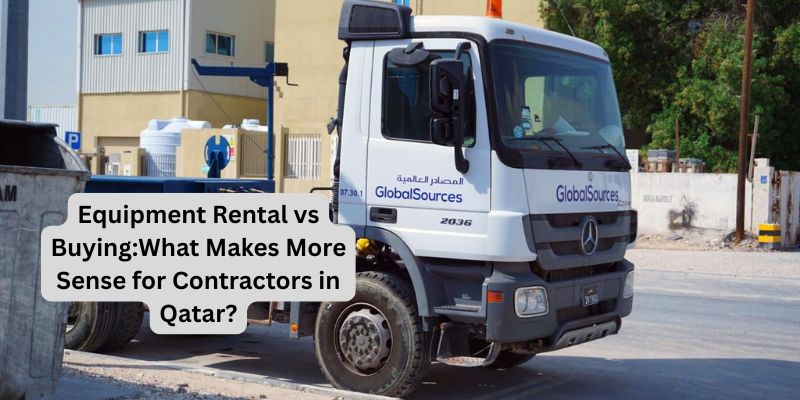
One of the most frequent decisions facing contractors in Qatar is whether to rent or buy heavy equipment. On the surface, buying looks cheaper over time. But when you factor in Qatar’s project-based work cycles, maintenance costs, certification requirements, and the sheer variety of machines needed — renting is often the smarter financial decision.
This guide lays out the honest cost and operational comparison to help Qatar contractors make the right call.
“Owning a crane that sits idle between projects is not an asset — it is a liability with a maintenance bill.”
The True Cost of Owning Equipment in Qatar
The purchase price is only the beginning. Equipment ownership in Qatar carries ongoing costs that many contractors underestimate: third-party inspection and certification (required annually in Qatar), operator salaries and benefits, maintenance and spare parts, insurance, storage at a certified yard, and mobilisation when projects start.
Cost Factor
Renting
Owning
Upfront Capital
None
Full purchase price or finance
Third-Party Inspection
Included by provider
Your cost — annually mandatory
Maintenance & Repairs
Included by provider
Your cost — can be significant
Operator
Included option
Salary + benefits + visa
Idle Period Cost
None — only pay when using
Full ownership cost continues
Certification Documentation
Provided by rental company
Your responsibility
Equipment Upgrades
Access newest fleet
Stuck with what you own
When Renting Is the Better Choice in Qatar
Project-based work where equipment is needed for 3–18 months then not required
Specialist equipment (crawler cranes, SPMTs, large generators) needed infrequently
Equipment required for a one-off project outside your normal fleet range
When full certification documentation is needed without internal compliance burden
When you need flexibility to scale equipment up or down as project phases change
When Buying Can Make Sense
Core equipment used continuously across multiple long-term projects (2+ years)
Standard equipment such as mid-size excavators or forklifts in continuous daily use
When you have a dedicated maintenance team and certified storage facility
When rental availability is consistently constrained in your market
STRATEGY: For most small and mid-size contractors in Qatar, renting 80% of the fleet and owning only the core day-to-day machines is the most cost-effective approach. It preserves capital, eliminates idle cost, and removes the certification and maintenance burden.
Global Sources Qatar provides flexible daily, weekly, and monthly equipment rental — no ownership costs, no certification burden, full documentation on every machine.
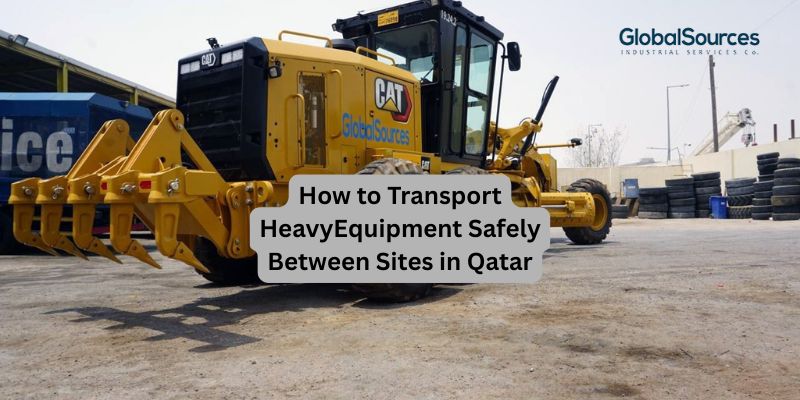
Moving heavy equipment between project sites in Qatar sounds straightforward — until you try to move a 60-ton excavator from Doha to Ras Laffan, or transport a pressure vessel module to Mesaieed Industrial City. The wrong trailer, a missing permit, or a driver without site access credentials can bring your entire operation to a halt.
This guide covers what Qatar contractors and project managers need to know about heavy equipment transport — from choosing the right trailer to navigating Qatar’s road permit process and meeting the specific requirements of oil & gas project sites.
“In Qatar, the transport plan is as important as the lift plan. A delay moving equipment to site costs the same as a delay on site.”
1. Choosing the Right Trailer for Your Equipment
The most common mistake in heavy equipment transport is selecting the wrong trailer type. Each trailer is designed for a specific load profile — getting this wrong risks equipment damage, safety incidents, and permit violations on Qatar’s road network.
Trailer Type
Max Payload
Best For
Common Qatar Use
Standard Flatbed
Up to 40T
Long, flat cargo — steel, pipes, materials
Construction material deliveries across Doha and Lusail
Low Bed Trailer
Up to 100T
Tall or heavy machinery that needs a low deck height
Transporting excavators, cranes, and bulldozers between Qatar sites
Semi Low Bed
Up to 60T
Medium-weight oversized equipment
Construction equipment and industrial units at Mesaieed & Ras Laffan
Multi-Axle Trailer
100T – 250T
Very heavy single loads requiring spread axles
Refinery vessels, transformers, large industrial modules
CRITICAL: A low bed trailer is not always the answer for heavy loads. If your load exceeds 100 tons, a multi-axle trailer configuration is required to spread the weight across more axles and comply with Qatar’s road load limits. Always confirm axle load limits with your transport provider before booking.
2. Qatar Road Permits for Oversized Loads
Any load that exceeds Qatar’s standard road dimensions — generally over 2.5 metres wide, 4.2 metres high, or 20 metres long — requires a road movement permit from the Qatar Ministry of Interior (MOI) before it can travel on public roads.
The permit process involves a route survey to identify low bridges, narrow roads, and utility crossings; a load calculation confirming axle weights within legal limits; and in some cases a police escort for very wide or long loads. Lead times for permits vary — allow 3 to 7 working days minimum for standard oversized loads, and longer for abnormal loads on complex routes.
Step 1: Route Survey Survey the full route from origin to destination. Identify obstacles, low bridges, tight turns, and utility crossings that require clearance.
Step 2: Load Confirm total weight and axle load distribution. Qatar’s axle load limits must not be
Calculationexceeded on any public road.
Step 3: MOI Permit Submit the permit application to Qatar Ministry of Interior with route plan, load drawings,
Applicationand vehicle specifications.
Step 4: Police Escort (if Loads over certain width/length thresholds require police escort during movement. Your
req.)transport provider handles coordination.
Step 5: Time Window Most oversized load movements in Qatar are restricted to specific hours — often night-time or early morning to minimise traffic impact.
3. What Is SPMT and When Is It Used in Qatar?
SPMT stands for Self-Propelled Modular Transporter — a platform vehicle with a large number of independently steered axle lines, capable of carrying virtually any load regardless of weight or size by adding more modules.
In Qatar, SPMTs are used almost exclusively for major oil & gas and industrial projects at Ras Laffan Industrial City and Mesaieed — transporting reactor vessels, heat exchangers, LNG plant modules, and large transformers that no conventional trailer can handle. SPMT moves are complex operations requiring engineering studies, dedicated traffic management, and highly experienced operators.
SPMT NOTE: If your project involves transporting any single item over 200 tons, or a load wider than 6 metres, ask your transport provider specifically about SPMT availability. Not all Qatar transport companies operate SPMTs — confirm capability before committing to a project schedule.
4. Transport Requirements for Ras Laffan & Mesaieed
Transporting equipment to Ras Laffan or Mesaieed is only half the challenge. Getting the equipment into these industrial cities has its own set of requirements that many contractors underestimate.
✔ Gate Access Pass All vehicles entering Ras Laffan Industrial City require a valid gate pass. Drivers must hold a valid Ras Laffan/QatarEnergy contractor card.
✔ Vehicle Inspection Transport vehicles are inspected at the gate for load security, tyre condition, lighting, and load documentation before entry is permitted.
✔ Load Securing Certificate All equipment must be properly secured and a load securing certificate provided.
Unsecured loads are turned away at the gate.
✔ Third-Party Inspection Equipment being delivered to oil & gas sites must carry a current third-party
inspection certificate to be accepted on site.
✔ Night Movement Some movements within Ras Laffan and Mesaieed are restricted to specific time
Restrictionwindows. Coordinate with your site contact in advance.
5. Pre-Booking Checklist — Before You Call a Transport Company
■ Know your equipment Length, width, height, and total weight of the load. Without this, no transport
dimensions and weight company can give you an accurate quote or begin the permit process.
■ Confirm your origin and From which yard or site is the equipment moving? To which gate or delivery point?
destinationBe specific — transport routes in Qatar vary significantly in complexity.
■ Check if a road permit is If your load exceeds standard road dimensions, allow 3–7 days minimum for permit
requiredapproval before your planned movement date.
■ Verify site access For Ras Laffan, Mesaieed, and other restricted sites — confirm what gate pass,
requirementsdriver credentials, and vehicle documentation are required before booking.
■ Confirm transport company Ask specifically whether your transport provider has moved equipment to your
experiencedestination before. Ras Laffan and Mesaieed experience is not universal.
Planning Your Transport Move in Qatar
Heavy equipment transport in Qatar requires the same level of planning as the construction operation itself. The right trailer, the right permits, and a transport partner with genuine Ras Laffan and Mesaieed experience makes the difference between a smooth delivery and a costly delay.
Whether you are moving a single excavator across Doha or transporting oversized industrial modules to Ras Laffan, the key is to plan early, confirm all documentation upfront, and work with a provider who knows Qatar’s roads, permits, and industrial zone requirements inside out.
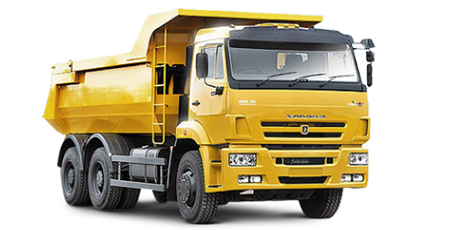
Global Sources Qatar provides low bed trailers, flatbeds, multi-axle trailers, SPMT, dump trucks, and water tankers across Qatar — with experienced drivers, full permit management, and Ras Laffan & Mesaieed access credentials.