globalsources

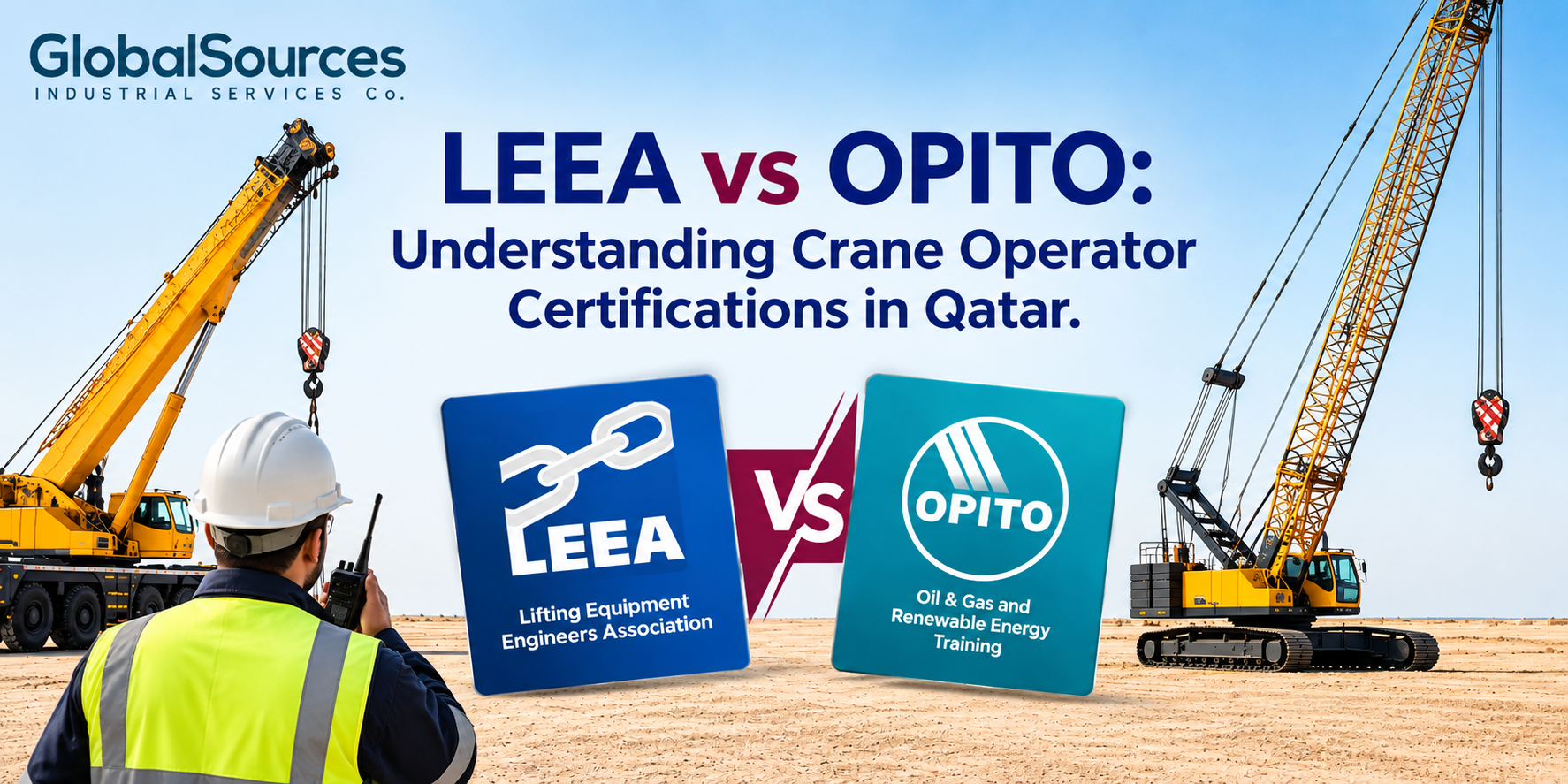
LEEA vs OPITO: Understanding Crane Operator Certifications in Qatar

When renting a crane in Qatar, one of the first questions your HSE team will ask is: what certifications do the operators hold? The two most commonly referenced certifications in Qatar are LEEA and OPITO. Many project managers use these terms interchangeably, but they cover different scopes and are required in different situations.

“Operator certifications are not a tick-box exercise. They represent the training and competency that keeps everyone on site safe during a lift.”

What Is LEEA Certification?

This guide explains what each certification means, which Qatar projects require which, and what to ask your crane rental provider.

LEEA stands for the Lifting Equipment Engineers Association — a UK-based international body that sets standards for lifting equipment safety and competency. LEEA certification covers a broad range of lifting operations including cranes, hoists, rigging, and lifting accessories. It is recognised across the construction, manufacturing, and general industrial sectors worldwide.

In Qatar, LEEA certification is widely accepted as the standard competency qualification for crane operators and riggers on construction and general industrial projects. It covers safe working practices, pre-use inspection, load assessment, and lift execution.

What Is OPITO Certification?

OPITO stands for the Offshore Petroleum Industry Training Organisation. It develops and manages competency standards specifically for the oil, gas, and energy sectors. OPITO certification for crane operators covers the additional requirements of operating in hazardous environments — including working near live process equipment, permit-to-work systems, and emergency procedures specific to oil and gas facilities.

In Qatar, OPITO certification is typically required for crane operations within QatarEnergy facilities, at Ras Laffan Industrial City, at offshore platforms, and on any project where the client specifies oil and gas sector standards.


LEEA vs OPITO — Which Does Your Project Need?


Project Type LEEA OPITO
General construction in Doha ■ Accepted Not typically required
Infrastructure projects ■ Accepted Not typically required
QatarEnergy projects ■ Often accepted ■ May be required — check contract
Ras Laffan Industrial City ■ Minimum standard ■ Often required
Mesaieed Industrial City ■ Minimum standard ■ Often required
Offshore lifting operations ■■ May not be sufficient ■ Required
RULE: When in doubt, ask your project HSE manager which certification standard applies before booking your crane and operator. If your contract specifies OPITO, LEEA alone will not satisfy the requirement.


What to Ask Your Crane Rental Provider

  • Which certifications do your operators hold — LEEA, OPITO, or both?
  • Are operator certification cards available for inspection before the crane arrives?
  • Are your operators experienced in QatarEnergy and Ras Laffan project environments?
  • Do your operators hold valid Qatar Civil Defence operator cards?


All Global Sources Qatar crane operators hold valid LEEA and OPITO certifications and Qatar Civil Defence operator cards. Documentation provided before mobilisation.
View our full services: globalsources.qa/heavy-light-lifting

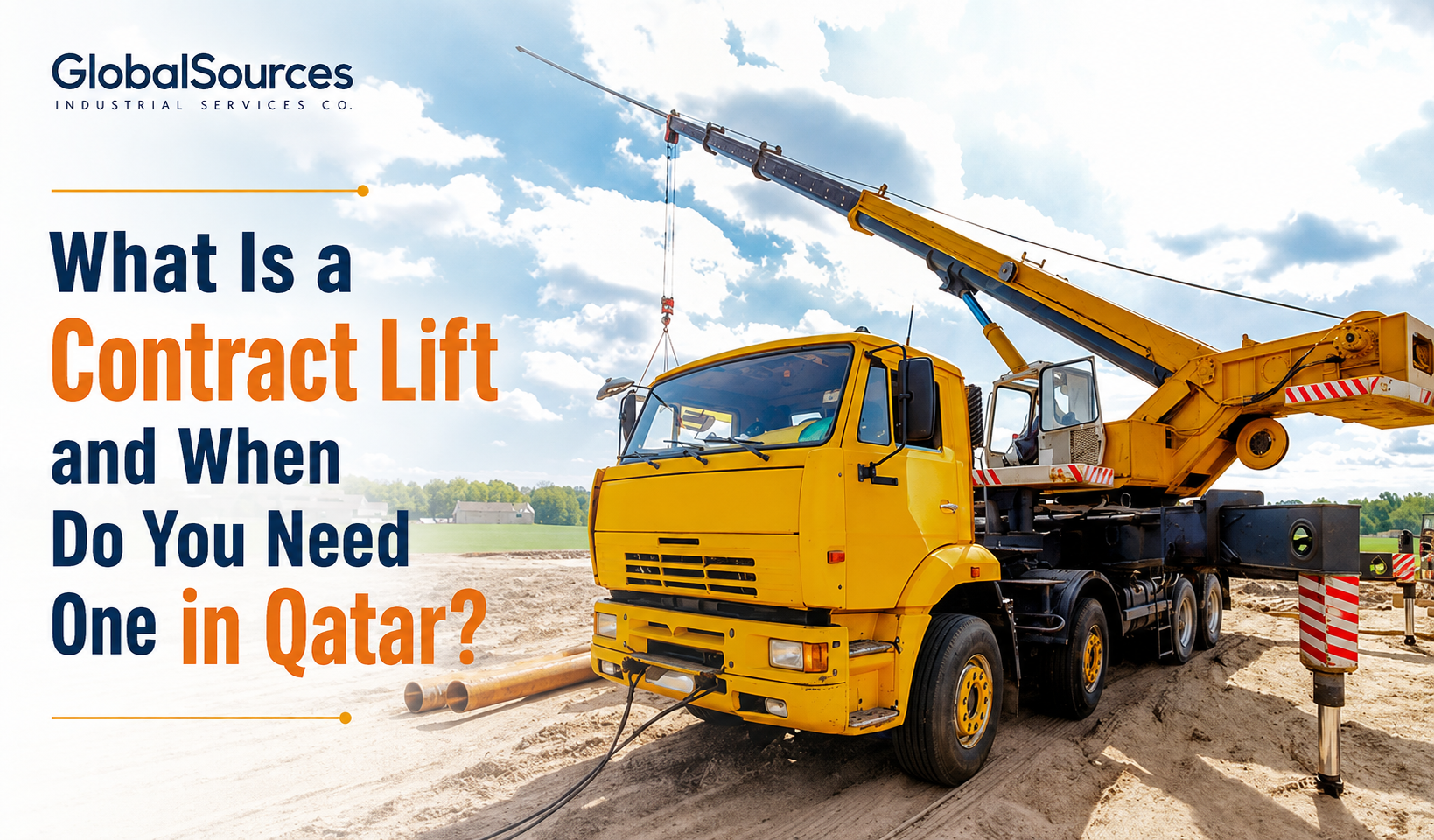
What Is a Contract Lift and When Do You Need One in Qatar?

In Qatar’s construction and oil and gas sector, two terms are commonly used when hiring a crane: crane hire and contract lift. They sound similar but they are fundamentally different in terms of responsibility, planning, and cost.

This guide explains what a contract lift is, how it differs from standard crane hire, and the specific situations in Qatar where a contract lift is the right — and sometimes the only — appropriate choice.

“With bare crane hire, the liability is yours. With a contract lift, the lifting contractor takes responsibility. That distinction matters enormously on high-value and critical lifts.”

Crane Hire vs Contract Lift — The Core Difference

Factor Bare Crane Hire Contract Lift
Equipment Supplied Crane only (or with operator) Crane + operator + rigging + lift plan
Lift Plan Your responsibility Lifting contractor’s responsibility
Liability Yours Lifting contractor’s
Rigging Your team Contractor’s certified riggers
Supervision Your lift supervisor Contractor’s appointed person
Best For Routine lifts with your own team Critical, complex, or high-value lifts
Cost Lower Higher — but includes all services


What Does a Contract Lift Include?

✔ Engineered lift plan Designed by a qualified lifting engineer for the specific lift
✔ Risk assessment and method statement RAMS covering every stage of the operation
✔ Crane and all equipment Including below-the-hook lifting gear and rigging equipment
✔ Certified crane operator Experienced and qualified for the specific machine
✔ Certified riggers LEEA-qualified riggers to attach and secure the load
✔ Appointed Person on site Responsible for supervising the entire lift operation

When Is a Contract Lift Required in Qatar?

A contract lift is strongly recommended — and often contractually required — in the following situations common across Qatar’s construction and oil and gas sector:

  • Lifts classified as critical — loads over 75% of crane rated capacity
  • Tandem lifts involving two or more cranes lifting simultaneously
  • Lifting over live process equipment at Ras Laffan or Mesaieed facilities
  • Lifts where your team does not have in-house LEEA-qualified riggers
  • EPC contracts that specify the lifting contractor must hold full responsibility
  • Any lift within QatarEnergy project environments requiring detailed lift plans
CHECK THIS If your project contract requires a ‘method statement with lift plan’ before any crane operation begins, you almost certainly need a contract lift, not bare crane hire. Check your contract requirements before booking.
Global Sources Qatar provides contract lifting services across Qatar — engineered lift plans, certified operators, LEEA riggers, and appointed persons for critical and complex lifts.
View our full services: globalsources.qa/heavy-light-lifting

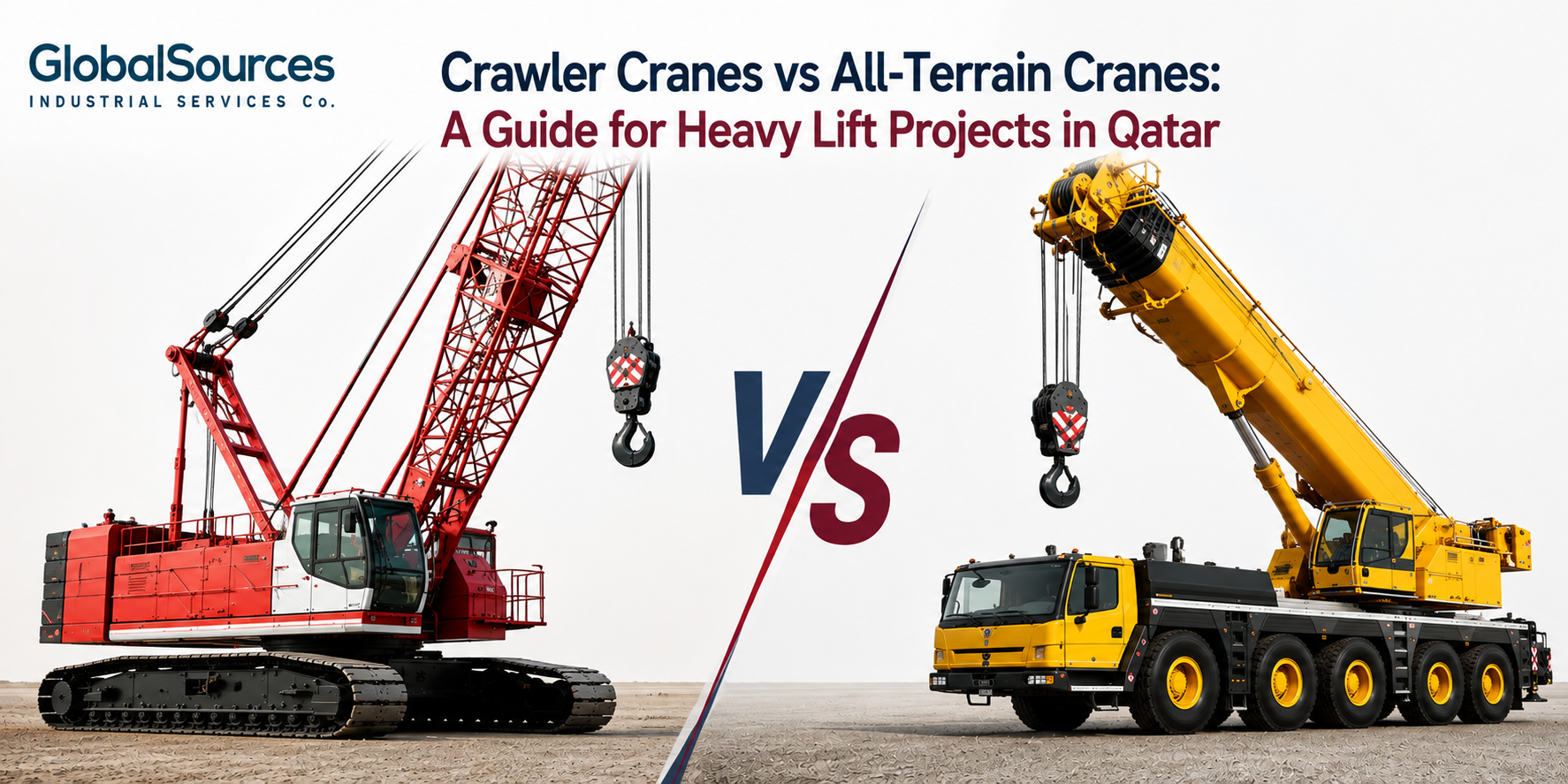
Crawler Cranes vs All-Terrain Cranes: A Guide for Heavy Lift Projects in Qatar

For most general construction lifts in Qatar, an all-terrain crane is the go-to solution. But for the heaviest lifts — LNG plant turnarounds, refinery module installation, and long-duration heavy lifts at Ras Laffan or Mesaieed — a crawler crane is often the only practical choice.

Understanding when a crawler crane makes more sense than an AT crane can save significant cost and planning time on your next major project.

“Crawler cranes don’t travel fast, but they lift heavy and stand firm. For the biggest lifts in Qatar, nothing else comes close.”

What Is a Crawler Crane?

A crawler crane is a lifting machine mounted on two sets of continuous tracks — like a tank — rather than tyres. The tracks distribute the crane’s weight over a very large footprint, allowing it to work on soft or variable ground without outriggers. Crawler cranes are capable of lifting and travelling with a load suspended — something no wheeled crane can safely do. Capacities range from 100 tons to over 3,500 tons for the largest lattice boom crawlers.

Key Differences: Crawler vs All-Terrain


Factor Crawler Crane All-Terrain Crane
Capacity Range 100T – 3,500T+ 50T – 1,200T
Ground Bearing Low — spreads weight over tracks High — requires solid ground or mats
Mobility Cannot travel on roads — requires transport Self-propelled on roads
Mobilisation Complex — disassembled for transport Simple — drives to site
Set-Up Time Hours to days 30–60 minutes
Duration Best for long-term site stays Best for single or short lifts
Load & Carry Can travel with load suspended Cannot


Qatar Use LNG plants, refineries, mega projects General construction, oil & gas

When to Choose a Crawler Crane in Qatar

Choose a crawler crane when your lift exceeds the capacity of available AT cranes, when you need to work on soft or variable ground, when the lift will take multiple days and the crane needs to remain in position, or when the project involves load-and-carry operations — moving a load while the crane is in motion.

In Qatar, crawler cranes are most commonly deployed at Ras Laffan Industrial City for LNG plant turnarounds, module lifts, and maintenance of QatarEnergy facilities; at Mesaieed for refinery and petrochemical projects; and on large infrastructure projects such as bridges and marine structures.

BUDGET NOTE: The biggest cost factor with crawler cranes in Qatar is mobilisation. Disassembling, transporting, and reassembling a large crawler crane typically takes 2–5 days. Build this into your project schedule and budget before committing.
Global Sources Qatar provides crawler cranes from 100T to 700T with certified operators for heavy lift projects at Ras Laffan, Mesaieed, and major Qatar infrastructure sites.
View our full services: globalsources.qa/heavy-light-lifting

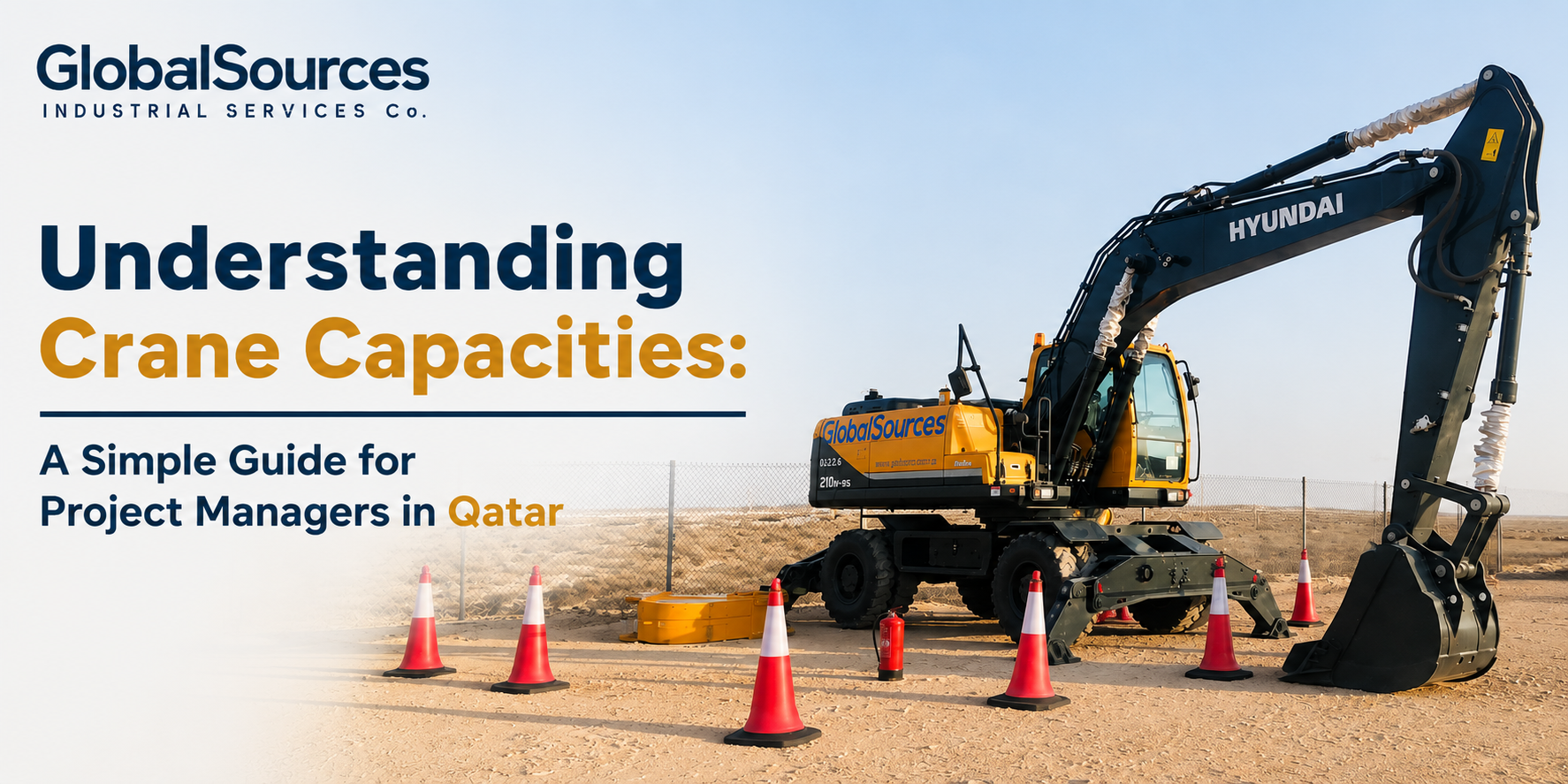
Understanding Crane Capacities: A Simple Guide for Project Managers in Qatar

Every crane has a headline capacity — 50 ton, 100 ton, 220 ton. But these numbers are frequently misunderstood by project managers, and that misunderstanding leads to dangerous undersizing or unnecessary overspend on rental.

This guide explains what crane capacity actually means, why the lift radius changes everything, and how to select the right crane tonnage for your Qatar project.

“A 100-ton crane can lift 100 tons — but only at the right radius. At 20 metres, it might only lift 30.”

What Does Crane Capacity Mean?

A crane’s rated capacity is the maximum load it can safely lift under ideal conditions — typically at the shortest possible radius (directly below the hook) and with the boom at its optimal angle. As the radius increases, the capacity drops significantly. This is governed by the crane’s load chart — a table or curve provided by the manufacturer showing safe lifting capacity at every combination of radius and boom length.

CRITICAL: Always request the load chart from your crane rental provider before confirming your booking. Without it, you cannot verify that the crane can safely perform your lift at your required radius.

How Radius Affects Capacity — A Practical Example

Crane Rating At 5m Radius At 10m Radius At 15m Radius At 20m Radius
50 Ton AT Crane 50T 32T 22T 15T
100 Ton AT Crane 100T 68T 42T 28T
220 Ton AT Crane 220T 140T 90T 58T

These figures are approximate and vary by crane model. The point is clear: the further the load is from the crane, the less it can safely lift. Always calculate your required lift capacity at your actual radius — not the headline tonnage.

Crane Capacity Selection Guide for Qatar Projects

Load Weight Required Radius Minimum Crane Size to Consider
Up to 10T Up to 15m 25–30 ton mobile crane
10T – 25T Up to 20m 50 ton all-terrain crane
25T – 50T Up to 20m 100 ton all-terrain crane
50T – 100T Up to 25m 220 ton all-terrain crane
Over 100T Any Crawler crane — consult lift engineer

Four Numbers You Must Have Before Booking

1 Load weight

The exact weight of the item being lifted, including all rigging and below-the-hook equipment.

2 Lift radius

The horizontal distance from the crane centre pin to the centre of the load at the pick-up and set-down points.

3 Required lift height

How high does the load need to travel? This determines boom length and configuration.

4 Headroom and obstructions

Are there overhead power lines, structures, or other cranes in the swing path?

Global Sources Qatar’s lifting team will review your load details and recommend the correct crane capacity for your project. Fleet ranges from 25T to 700T across Qatar.
View our full services: globalsources.qa/heavy-light-lifting

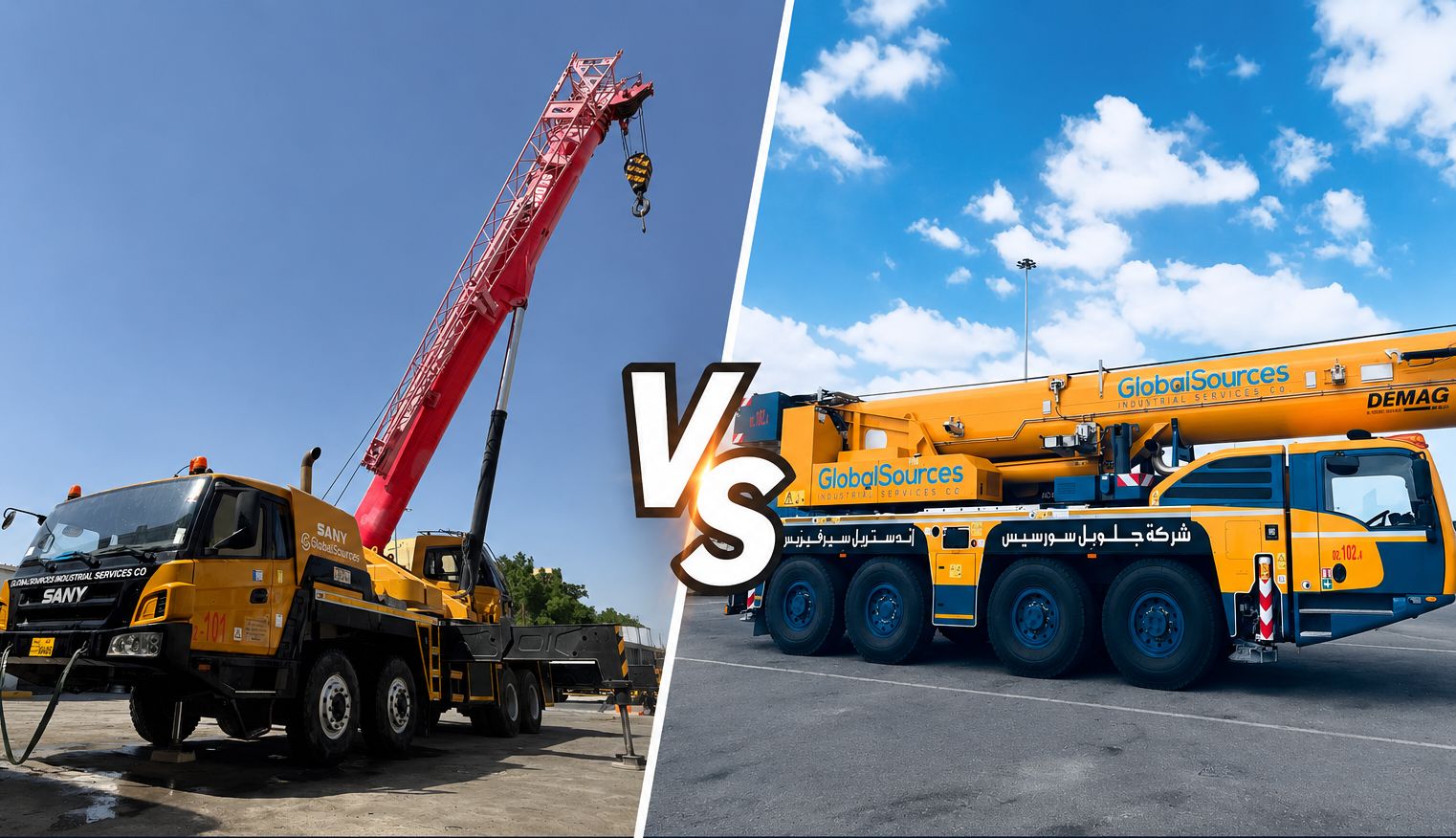
All-Terrain Cranes vs Mobile Cranes: Which One Does Your Project Need?

All-terrain cranes and mobile cranes are the two most commonly rented crane types in Qatar. Both are wheeled, both are self-propelled, and both can handle a wide range of lifts. But they are different machines designed for different conditions — and choosing the wrong one will cost you.

This guide explains the key differences and helps you decide which type is right for your Qatar project.

“All-terrain cranes go everywhere. Mobile cranes go fast. The question is which one your site actually needs.”

All-Terrain Cranes — What They Are and When to Use Them

All-terrain cranes (AT cranes) are designed to travel on both public highways and rough, unpaved terrain. They have multi-axle all-wheel-drive and all-wheel-steer systems that allow them to manoeuvre in tight spaces and on uneven ground. In Qatar, AT cranes are the most commonly rented crane type — used on construction sites, oil and gas facilities, infrastructure projects, and anywhere that requires both road travel and off-road access.

Popular AT crane brands in Qatar include Liebherr LTM, Grove GMK, and Tadano ATF series, available in capacities from 50 tons to 500 tons.

Mobile Cranes — What They Are and When to Use Them

Mobile cranes — sometimes called truck cranes or hydraulic truck cranes — are mounted on a standard truck carrier. They travel on public roads at normal highway speeds and set up quickly at site. They are ideal for projects where fast mobilisation and frequent repositioning are priorities. Mobile cranes are widely used in Qatar for construction, maintenance, and equipment installation where the site has good road access and relatively flat ground.

Direct Comparison


Feature All-Terrain Crane Mobile Crane
Road Travel Speed Up to 80 km/h Up to 80 km/h
Off-Road Capability Excellent — all-wheel drive Limited — road surfaces only
Capacity Range 50T – 1,200T 25T – 220T
Set-Up Time 30–60 minutes 15–30 minutes
Best For Oil & gas, rough terrain, large lifts Fast mobilisation, frequent moves
Qatar Usage Ras Laffan, Mesaieed, large construction General Doha construction, maintenance
RECOMMEND ATION
For most large construction and oil & gas projects in Qatar, an all-terrain crane is the safer and more versatile choice. If your priority is speed and your site has good road access, a mobile crane will be faster to mobilise and set up.

Which One Is Right for Your Project?

Choose an all-terrain crane if: your site has unpaved or uneven ground, you are working at Ras Laffan or Mesaieed, you need a capacity over 100 tons, or your lift will involve long durations.

Choose a mobile crane if: your site has good road access, you need fast mobilisation, you are doing frequent repositioning lifts, or your lift is under 100 tons on a flat prepared surface.

Global Sources Qatar operates Liebherr, Grove, and Tadano all-terrain cranes and mobile cranes with certified operators across all Qatar project locations.
View our full services: globalsources.qa/heavy-light-lifting

Types of Cranes Used in Qatar’s Construction and Industrial Projects

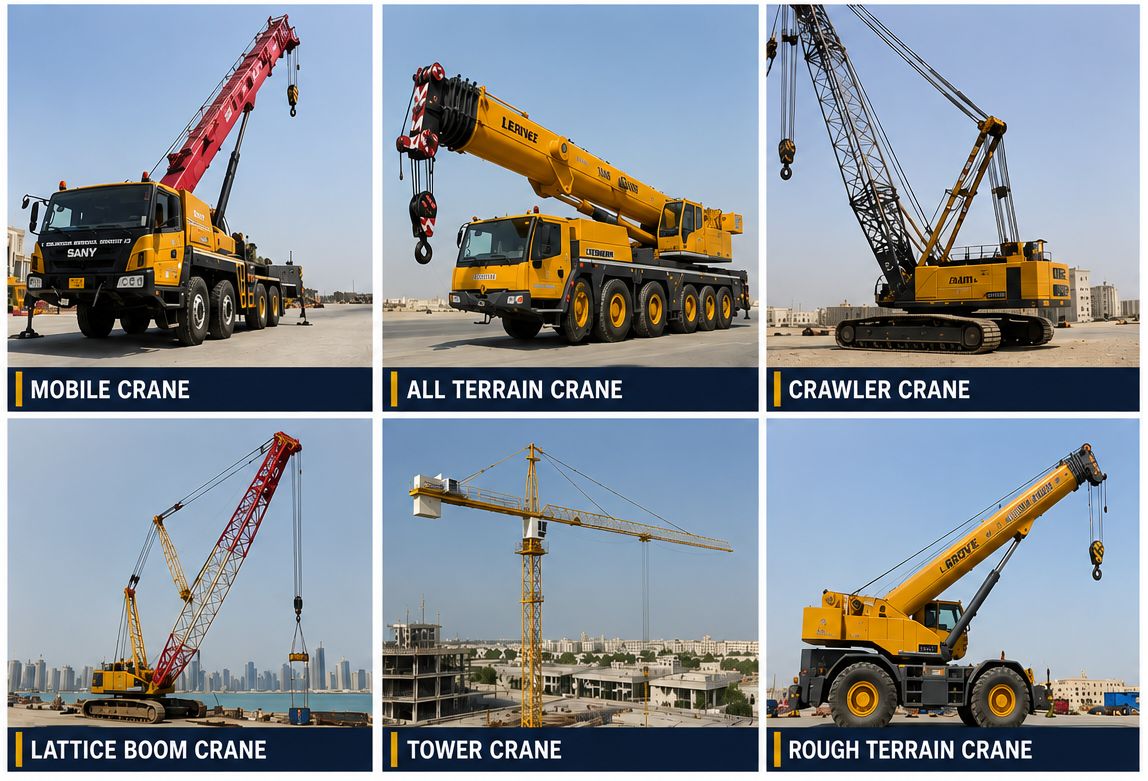
Qatar’s construction and industrial landscape requires a wide variety of crane types. From compact city cranes navigating Doha’s dense urban environment to massive crawler cranes at Ras Laffan’s LNG facilities — each crane type serves a specific purpose and performs best in specific conditions.

This overview covers every crane type commonly used in Qatar, what each is designed for, and where you are most likely to see them deployed.

“There is no single best crane. There is only the right crane for the job in front of you.”

Overview of Crane Types in Qatar

Crane Type Capacity Range Primary Use in Qatar
All-Terrain (AT) 50T – 1,200T Construction, oil & gas, infrastructure — the most versatile and most-rented crane in Qatar
Mobile / Truck Crane 25T – 220T Fast mobilisation, general construction and maintenance, frequent repositioning
Rough Terrain 30T – 130T Off-road sites — oil & gas pipelines, uneven industrial ground, remote locations
Crawler Crane 100T – 3,500T Heaviest lifts — LNG plants, refinery turnarounds, Ras Laffan and Mesaieed projects
Tower Crane Up to 20T at radius High-rise building construction in Doha and Lusail City
Truck Mounted 15T – 70T Utility, MEP installation, rapid response — crane on a road truck
Pick & Carry 10T – 50T Confined industrial spaces — can travel with suspended load

Most Commonly Used Crane Types in Qatar

All-terrain cranes are by far the most rented crane type in Qatar, accounting for the majority of crane hire across construction, oil and gas, and infrastructure sectors. Their ability to travel on roads at highway speed and then operate off-road makes them ideal for Qatar’s diverse project environments.

Tower cranes are predominantly deployed in Doha’s high-rise construction zones and the ongoing Lusail City urban development programme. They provide continuous vertical lifting for multi-storey structures where an AT crane would need to be constantly repositioned.

Crawler cranes are the workhorse of Qatar’s heavy industrial sector — specifically at Ras Laffan and Mesaieed where the heaviest lifts occur. Their stability on soft ground and ability to carry loads while moving makes them essential for LNG plant maintenance and large module placement.

Choosing the Right Crane Type for Your Qatar Project

✔ For construction in Doha or Lusail All-terrain or mobile crane for most lifts. Tower crane for high-rise.
✔ For oil & gas at Ras Laffan or Mesaieed All-terrain crane for general lifts. Crawler crane for heavy or long-duration.
✔ For off-road or unpaved sites Rough terrain crane with four-wheel drive.
✔ For utility and MEP work Truck-mounted crane for fast, road-based response.
✔ For confined industrial spaces Pick and carry crane for manoeuvring with suspended load.

Global Sources Qatar operates all crane types — AT, mobile, rough terrain, crawler, tower, and truck-mounted — with certified operators across all Qatar project locations.

View our full services: globalsources.qa/heavy-light-lifting

Best Industrial Service Provider in Qatar - Global Sources Doha

Do You Want To Talk With Us? So Don't be Late.

Call Us: +974 4468 5501