globalsources

All-Terrain Cranes vs Mobile Cranes: Which One Does Your Project Need?

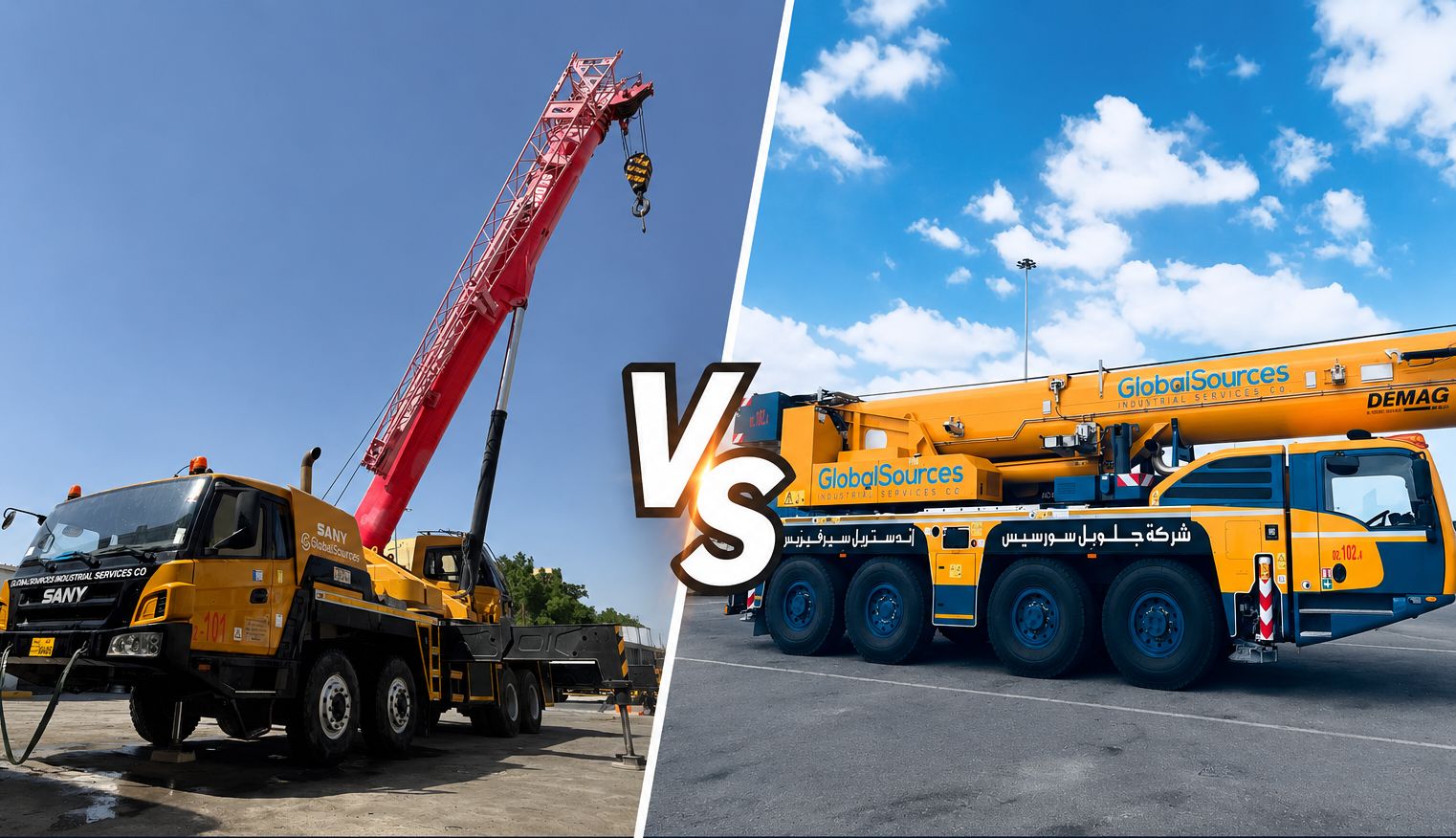
All-terrain cranes and mobile cranes are the two most commonly rented crane types in Qatar. Both are wheeled, both are self-propelled, and both can handle a wide range of lifts. But they are different machines designed for different conditions — and choosing the wrong one will cost you.

This guide explains the key differences and helps you decide which type is right for your Qatar project.

“All-terrain cranes go everywhere. Mobile cranes go fast. The question is which one your site actually needs.”

All-Terrain Cranes — What They Are and When to Use Them

All-terrain cranes (AT cranes) are designed to travel on both public highways and rough, unpaved terrain. They have multi-axle all-wheel-drive and all-wheel-steer systems that allow them to manoeuvre in tight spaces and on uneven ground. In Qatar, AT cranes are the most commonly rented crane type — used on construction sites, oil and gas facilities, infrastructure projects, and anywhere that requires both road travel and off-road access.

Popular AT crane brands in Qatar include Liebherr LTM, Grove GMK, and Tadano ATF series, available in capacities from 50 tons to 500 tons.

Mobile Cranes — What They Are and When to Use Them

Mobile cranes — sometimes called truck cranes or hydraulic truck cranes — are mounted on a standard truck carrier. They travel on public roads at normal highway speeds and set up quickly at site. They are ideal for projects where fast mobilisation and frequent repositioning are priorities. Mobile cranes are widely used in Qatar for construction, maintenance, and equipment installation where the site has good road access and relatively flat ground.

Direct Comparison


Feature All-Terrain Crane Mobile Crane
Road Travel Speed Up to 80 km/h Up to 80 km/h
Off-Road Capability Excellent — all-wheel drive Limited — road surfaces only
Capacity Range 50T – 1,200T 25T – 220T
Set-Up Time 30–60 minutes 15–30 minutes
Best For Oil & gas, rough terrain, large lifts Fast mobilisation, frequent moves
Qatar Usage Ras Laffan, Mesaieed, large construction General Doha construction, maintenance
RECOMMEND ATION
For most large construction and oil & gas projects in Qatar, an all-terrain crane is the safer and more versatile choice. If your priority is speed and your site has good road access, a mobile crane will be faster to mobilise and set up.

Which One Is Right for Your Project?

Choose an all-terrain crane if: your site has unpaved or uneven ground, you are working at Ras Laffan or Mesaieed, you need a capacity over 100 tons, or your lift will involve long durations.

Choose a mobile crane if: your site has good road access, you need fast mobilisation, you are doing frequent repositioning lifts, or your lift is under 100 tons on a flat prepared surface.

Global Sources Qatar operates Liebherr, Grove, and Tadano all-terrain cranes and mobile cranes with certified operators across all Qatar project locations.
View our full services: globalsources.qa/heavy-light-lifting

Types of Cranes Used in Qatar’s Construction and Industrial Projects

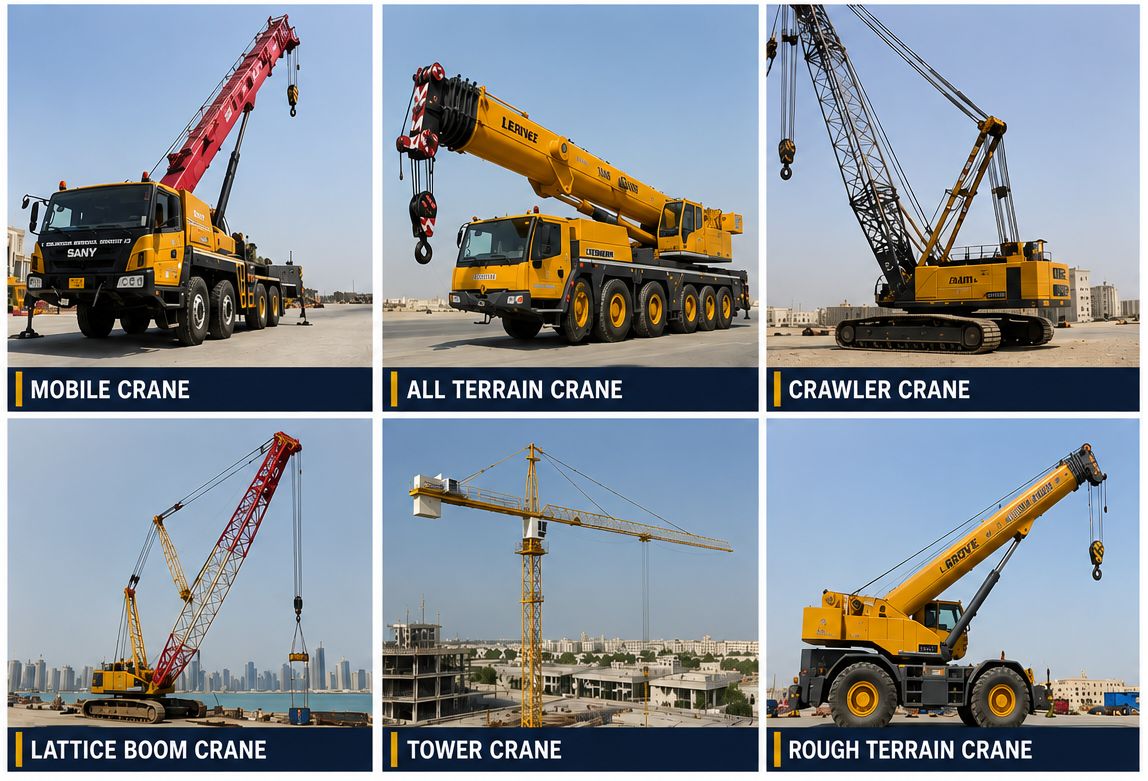
Qatar’s construction and industrial landscape requires a wide variety of crane types. From compact city cranes navigating Doha’s dense urban environment to massive crawler cranes at Ras Laffan’s LNG facilities — each crane type serves a specific purpose and performs best in specific conditions.

This overview covers every crane type commonly used in Qatar, what each is designed for, and where you are most likely to see them deployed.

“There is no single best crane. There is only the right crane for the job in front of you.”

Overview of Crane Types in Qatar

Crane Type Capacity Range Primary Use in Qatar
All-Terrain (AT) 50T – 1,200T Construction, oil & gas, infrastructure — the most versatile and most-rented crane in Qatar
Mobile / Truck Crane 25T – 220T Fast mobilisation, general construction and maintenance, frequent repositioning
Rough Terrain 30T – 130T Off-road sites — oil & gas pipelines, uneven industrial ground, remote locations
Crawler Crane 100T – 3,500T Heaviest lifts — LNG plants, refinery turnarounds, Ras Laffan and Mesaieed projects
Tower Crane Up to 20T at radius High-rise building construction in Doha and Lusail City
Truck Mounted 15T – 70T Utility, MEP installation, rapid response — crane on a road truck
Pick & Carry 10T – 50T Confined industrial spaces — can travel with suspended load

Most Commonly Used Crane Types in Qatar

All-terrain cranes are by far the most rented crane type in Qatar, accounting for the majority of crane hire across construction, oil and gas, and infrastructure sectors. Their ability to travel on roads at highway speed and then operate off-road makes them ideal for Qatar’s diverse project environments.

Tower cranes are predominantly deployed in Doha’s high-rise construction zones and the ongoing Lusail City urban development programme. They provide continuous vertical lifting for multi-storey structures where an AT crane would need to be constantly repositioned.

Crawler cranes are the workhorse of Qatar’s heavy industrial sector — specifically at Ras Laffan and Mesaieed where the heaviest lifts occur. Their stability on soft ground and ability to carry loads while moving makes them essential for LNG plant maintenance and large module placement.

Choosing the Right Crane Type for Your Qatar Project

For construction in Doha or Lusail All-terrain or mobile crane for most lifts. Tower crane for high-rise.
For oil & gas at Ras Laffan or Mesaieed All-terrain crane for general lifts. Crawler crane for heavy or long-duration.
For off-road or unpaved sites Rough terrain crane with four-wheel drive.
For utility and MEP work Truck-mounted crane for fast, road-based response.
For confined industrial spaces Pick and carry crane for manoeuvring with suspended load.

Global Sources Qatar operates all crane types — AT, mobile, rough terrain, crawler, tower, and truck-mounted — with certified operators across all Qatar project locations.

View our full services: globalsources.qa/heavy-light-lifting

How to Choose the Right Crane for Your Project in Qatar

Choosing the wrong crane is one of the most expensive mistakes a project manager can make in Qatar. Too small and your lift is unsafe. Wrong type and your crane cannot access the site. No operator included and you face compliance issues before the lift even starts.

This guide covers the four key decisions you need to make when selecting a crane for your Qatar project — and what to check before the machine arrives on site.

“The right crane is not always the biggest crane. It is the one that fits the load, the site, and the timeline.”

1. Identify Your Load Weight and Lift Radius

The two most important numbers in crane selection are the load weight and the lift radius — the horizontal distance from the crane centre pin to where the load will be placed. A crane’s capacity drops dramatically as the radius increases. A 100-ton crane may only safely lift 25 tons at a 20-metre radius. Always ask your rental provider for a crane load chart before confirming your booking.

CRITICAL: Never go by headline tonnage alone. Always provide your load weight AND the required lift radius. These two numbers together determine the crane you actually need.

2. Match the Crane Type to Your Site Conditions

Site Condition Best Crane Type Why
Paved roads + outdoor site All-Terrain Crane Travels on public roads, sets up fast, high capacity
Rough or unpaved ground Rough Terrain Crane Four-wheel drive, designed for off-road conditions
High-rise building site Tower Crane Continuous vertical lifting over a large radius
Long-duration heavy lift Crawler Crane Maximum stability, no outrigger space needed
Urban / confined space City or Compact Crane Smaller footprint, fits tight streets in Doha

3. Confirm Site Access Before Booking

One of the most common causes of crane rental delays in Qatar is a crane arriving on site that cannot physically access the lift position. Before confirming any crane, provide your rental provider with the site access route, gate width, overhead clearance, and ground bearing capacity. For Ras Laffan and Mesaieed, also confirm that the crane and driver hold valid site access credentials.

4. Decide on Operator and Rigging Requirements

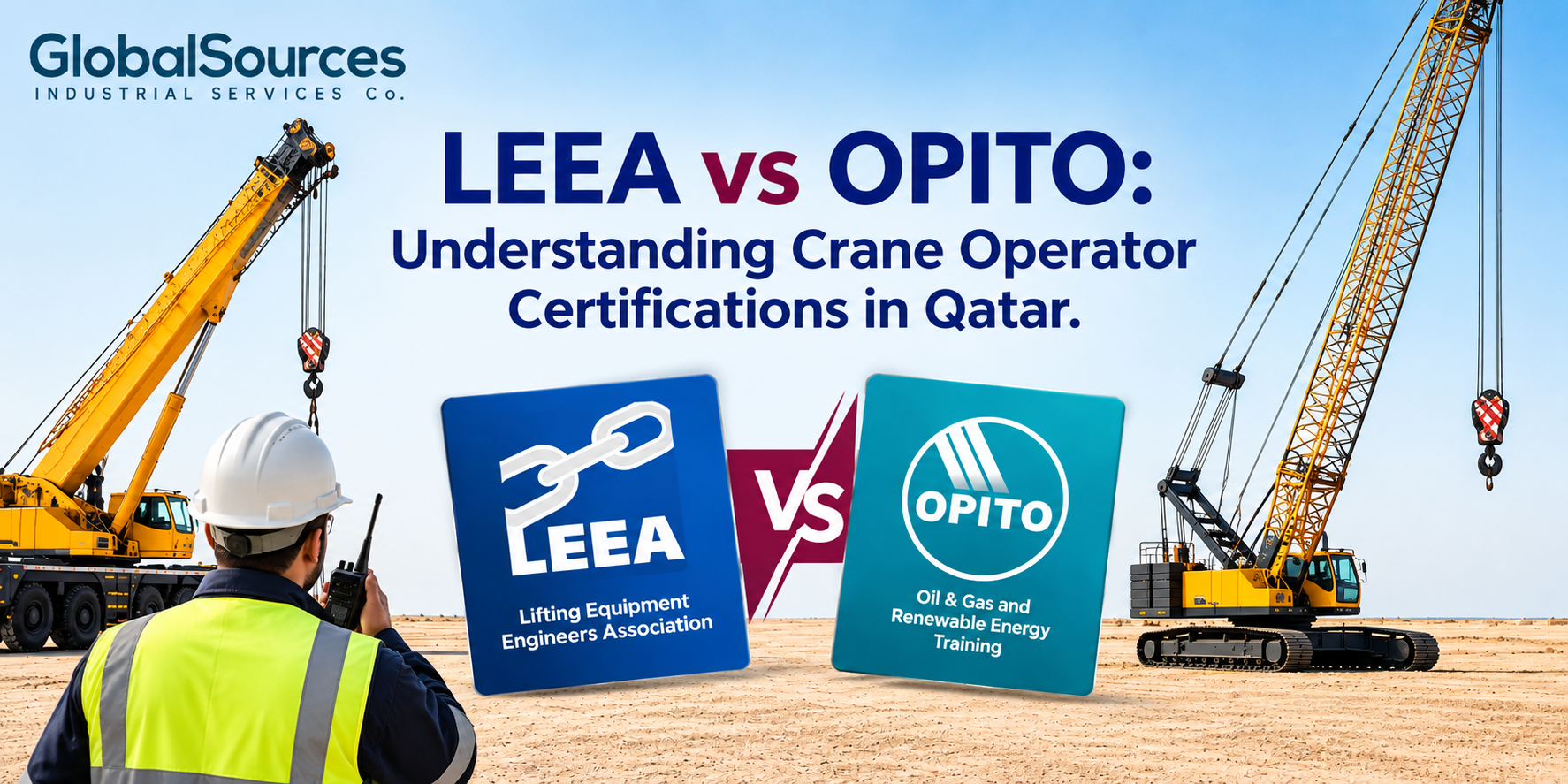
In Qatar, crane operators must hold valid certifications — LEEA, OPITO, and Qatar Civil Defence compliance are the standard requirements. Renting a crane with a certified operator included removes the compliance burden from your team, reduces your liability, and ensures the operator is familiar with the specific machine.

Load weight and lift radius confirmed Exact figures, not estimates
Crane type matches site conditions AT, mobile, crawler, or tower
Site access route checked Gate width, overhead clearance, ground bearing
Operator certification confirmed LEEA, OPITO, Qatar Civil Defence
Inspection certificate requested Third-party cert required for all lifts

Global Sources Qatar provides mobile, all-terrain, rough terrain, crawler, and tower cranes with LEEA-certified operators across Doha, Ras Laffan, Lusail, and Mesaieed.

View our full services: globalsources.qa/heavy-light-lifting


Best Industrial Service Provider in Qatar - Global Sources Doha

Do You Want To Talk With Us? So Don't be Late.

Call Us: +974 4468 5501