globalsources

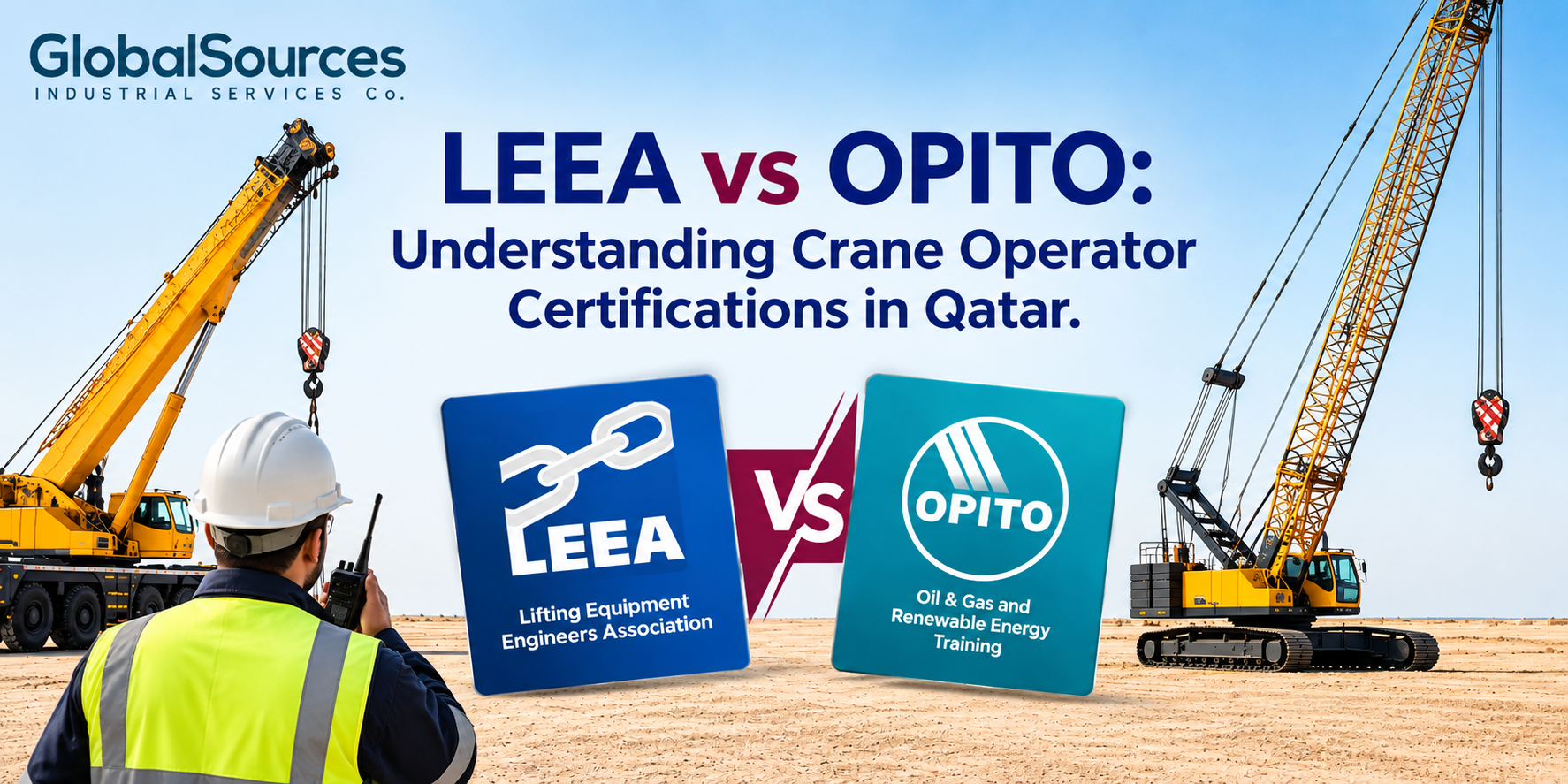
LEEA vs OPITO: Understanding Crane Operator Certifications in Qatar

When renting a crane in Qatar, one of the first questions your HSE team will ask is: what certifications do the operators hold? The two most commonly referenced certifications in Qatar are LEEA and OPITO. Many project managers use these terms interchangeably, but they cover different scopes and are required in different situations.

“Operator certifications are not a tick-box exercise. They represent the training and competency that keeps everyone on site safe during a lift.”

What Is LEEA Certification?

This guide explains what each certification means, which Qatar projects require which, and what to ask your crane rental provider.

LEEA stands for the Lifting Equipment Engineers Association — a UK-based international body that sets standards for lifting equipment safety and competency. LEEA certification covers a broad range of lifting operations including cranes, hoists, rigging, and lifting accessories. It is recognised across the construction, manufacturing, and general industrial sectors worldwide.

In Qatar, LEEA certification is widely accepted as the standard competency qualification for crane operators and riggers on construction and general industrial projects. It covers safe working practices, pre-use inspection, load assessment, and lift execution.

What Is OPITO Certification?

OPITO stands for the Offshore Petroleum Industry Training Organisation. It develops and manages competency standards specifically for the oil, gas, and energy sectors. OPITO certification for crane operators covers the additional requirements of operating in hazardous environments — including working near live process equipment, permit-to-work systems, and emergency procedures specific to oil and gas facilities.

In Qatar, OPITO certification is typically required for crane operations within QatarEnergy facilities, at Ras Laffan Industrial City, at offshore platforms, and on any project where the client specifies oil and gas sector standards.


LEEA vs OPITO — Which Does Your Project Need?


Project Type LEEA OPITO
General construction in Doha ■ Accepted Not typically required
Infrastructure projects ■ Accepted Not typically required
QatarEnergy projects ■ Often accepted ■ May be required — check contract
Ras Laffan Industrial City ■ Minimum standard ■ Often required
Mesaieed Industrial City ■ Minimum standard ■ Often required
Offshore lifting operations ■■ May not be sufficient ■ Required
RULE: When in doubt, ask your project HSE manager which certification standard applies before booking your crane and operator. If your contract specifies OPITO, LEEA alone will not satisfy the requirement.


What to Ask Your Crane Rental Provider

  • Which certifications do your operators hold — LEEA, OPITO, or both?
  • Are operator certification cards available for inspection before the crane arrives?
  • Are your operators experienced in QatarEnergy and Ras Laffan project environments?
  • Do your operators hold valid Qatar Civil Defence operator cards?


All Global Sources Qatar crane operators hold valid LEEA and OPITO certifications and Qatar Civil Defence operator cards. Documentation provided before mobilisation.
View our full services: globalsources.qa/heavy-light-lifting

Top 5 Mistakes to Avoid When Renting a Crane in Qatar

Crane rental mistakes in Qatar are surprisingly common — and surprisingly expensive. A wrong crane type, an underpowered machine, a missing inspection certificate, or an operator without the right certification can each bring your project to a costly standstill.

Here are the five most common crane rental mistakes made by contractors in Qatar, and exactly how to avoid them.

“Most crane rental problems in Qatar are avoidable. They happen not because of bad luck but because of insufficient planning before the crane is booked.”

Mistake 1: Choosing by Headline Tonnage, Not by Radius

The single most common mistake. A contractor sees they need to lift 40 tons, searches for a ’50-ton crane’, and assumes the job is done. In reality, crane capacity at 15 or 20 metres radius may be half the headline rating. Always provide your load weight and lift radius together. Never book a crane based on capacity alone.

Mistake 2: Not Checking Site Access Before the Crane Arrives

A crane that cannot access the lift position is useless — and you are still paying for the day. Before booking, provide your rental provider with the access route dimensions (gate width, height restrictions, turning radius), ground bearing capacity, and for Ras Laffan or Mesaieed, site access credential requirements for the crane and driver.

Mistake 3: Accepting a Crane Without Valid Documentation

Never accept a crane on site without a current third-party inspection certificate, a valid load test record, and operator certification documentation. In Qatar, operating lifting equipment without valid certificates is a safety violation and can result in your project being shut down by the site HSE team or authorities.

Mistake 4: Underestimating Mobilisation Time

Standard mobile and all-terrain cranes typically arrive same-day or next-day in Qatar. Crawler cranes require disassembly, transport, and reassembly — which can take 2 to 5 days. If your project schedule relies on a crawler crane and you book it without allowing for mobilisation, your critical path will slip before the lift even starts.

Mistake 5: Not Confirming Operator Certification Matches Project Requirements

Some Qatar projects — particularly QatarEnergy, Ras Laffan, and Mesaieed environments — specify OPITO-certified operators as a minimum. A LEEA-certified operator may not satisfy this requirement. Always check your project contract’s certification requirements before booking an operator, and confirm the rental company’s operators meet those specific requirements.

Global Sources Qatar provides fully certified cranes, LEEA and OPITO-qualified operators, and all documentation as standard on every rental across Qatar.
View our full services: globalsources.qa/heavy-light-lifting

How to Plan a Critical Lift for Oil & Gas Projects in Qatar

Critical lifts are among the highest-risk operations on any oil and gas project. In Qatar’s Ras Laffan Industrial City and Mesaieed Industrial City — where lifting operations occur daily within live process environments — a thorough critical lift plan is not a bureaucratic requirement. It is what keeps people alive.

This guide outlines the step-by-step process for planning a critical lift on a Qatar oil and gas project, from initial classification through to completion.

“A well-planned lift is a safe lift. The engineering work done before the crane arrives is what
determines whether the operation succeeds.”


What Classifies a Lift as Critical in Qatar?

  • Load exceeds 75% of the crane’s rated capacity at the required radius
  • Two or more cranes are involved in a single lift (tandem lift)
  • Lift is conducted over live process equipment or energised systems
  • Personnel are required to ride the load or be within the lift zone
  • Unusual rigging configurations such as spreader beams or custom lifting frames
  • Lifts at extreme radii or with very limited headroom
  • QatarEnergy or project HSE plan specifically classifies the lift as critical

The Critical Lift Planning Process

1 Lift Classification
Determine whether the lift meets critical lift criteria. Document the classification decision with supporting calculations.
2 Scope of Lift
Define the load weight, dimensions, centre of gravity, lift height, radius, and pick-up and set-down positions.
3 Crane Selection

Select the crane based on load chart verification — not estimated capacity. Confirm the crane can safely perform the lift at the required radius.

4 Engineered Lift Plan
A qualified lifting engineer prepares the lift plan including crane configuration, outrigger loads, rigging arrangement, and lift sequence.
5 Risk Assessment (RAMS)

Identify all hazards — overhead obstructions, ground conditions, weather limits, personnel exclusion zones, and emergency procedures.

6 Permit to Work

Obtain the required site permit — in Qatar oil and gas environments this is a mandatory step before any crane is mobilised.

7 Pre-Lift Meeting

Conduct a toolbox talk with all personnel involved — crane operator, riggers, signallers, supervisor, and site safety officer.

8 Execute and Document

Carry out the lift per the plan. Document any deviations. Complete lift records for project files.


QatarEnergy and Ras Laffan Specific Requirements

For lifts within QatarEnergy project environments, the lift plan must typically be reviewed and approved by the project HSE team and in some cases by QatarEnergy’s own lifting authority before work can begin. Third-party verification of the lift plan is often required for critical lifts over certain thresholds. Ensure your crane rental provider has experience working within QatarEnergy environments and can provide the documentation format your project requires.

TIMELINE Allow 5 10 working days for critical lift plan preparation, review, and approval in a QatarEnergy project environment. Last-minute critical lift planning is the most common cause of lifting delays at Ras Laffan.


Global Sources Qatar provides complete critical lift support — engineered lift plans, appointed persons, certified operators, and LEEA riggers for Ras Laffan and Mesaieed projects.
View our full services: globalsources.qa/heavy-light-lifting


Crane Safety Standards and Regulations on Qatar Construction Sites

Qatar’s construction and industrial sectors operate under strict safety regulations covering crane operations, operator qualifications, and lifting equipment. For EPC contractors, main contractors, and subcontractors operating in Qatar, understanding these requirements is not optional — non-compliance can result in site stoppages, fines, and serious liability.

This guide covers the key crane safety standards that apply to construction and industrial projects in Qatar.

“In Qatar, a crane without its inspection certificate is not a crane — it is a liability. Never accept lifting equipment on site without full documentation.”

Qatar Civil Defence (QCDD) Requirements

Qatar Civil Defence (QCDD) is the primary authority responsible for crane safety regulations in Qatar. Key requirements include mandatory inspection of all cranes and lifting equipment before use, valid load test certificates not older than 12 months, operator competency cards confirming current certification, and compliance with Qatar’s fire and safety code for cranes operating near structures.

All cranes deployed on Qatar projects must carry a current QCDD-compliant inspection record. This is a site access requirement — not a courtesy.

Operator Certification Requirements

Certification Issued By Requirement Level Scope
LEEA Certification Lifting Equipment Engineers Association Highly recommended Comprehensive crane and lifting equipment competency
OPITO Certification Offshore Petroleum Industry Training Organisation Required for oil & gas Mandatory for offshore and energy sector projects
Qatar Civil Defence Card QCDD Mandatory in Qatar All crane operators must hold this to operate legally
Competency Assessment Project HSE team Often required by EPC contractors Site-specific assessment for complex projects


Pre-Lift Documentation Checklist

✔ Third-party inspection certificate Current and valid — not older than 12 months
✔ Load test certificate Confirms safe working load at all configurations
✔ Operator competency card Valid Qatar Civil Defence operator card
✔ Lift plan Required for all non-routine and critical lifts
✔ Risk assessment (RAMS) Method statement for the specific lift operation
✔ Site permit to work Signed and in place before lift commences


STANDARD
PRACTICE

If you are renting a crane in Qatar, always request all of the above documents from
your provider before the crane arrives on site. Any reputable crane rental company will provide these as standard.


Critical Lift Requirements

Qatar and international standards define a critical lift as any lift where the load exceeds 75% of the crane’s rated capacity, involves more than one crane, is conducted over live process equipment, or involves unusual rigging configurations. Critical lifts in Qatar require a formal engineered lift plan approved by a qualified engineer, an appointed person on site, and in many cases a third-party lift supervisor.

All cranes from Global Sources Qatar come with current QCDD-compliant inspection certificates, load test records, and certified operators. Full documentation provided on every rental.


View our full services: globalsources.qa/heavy-light-lifting

What Is a Contract Lift and When Do You Need One in Qatar?

In Qatar’s construction and oil and gas sector, two terms are commonly used when hiring a crane: crane hire and contract lift. They sound similar but they are fundamentally different in terms of responsibility, planning, and cost.

This guide explains what a contract lift is, how it differs from standard crane hire, and the specific situations in Qatar where a contract lift is the right — and sometimes the only — appropriate choice.

“With bare crane hire, the liability is yours. With a contract lift, the lifting contractor takes responsibility. That distinction matters enormously on high-value and critical lifts.”

Crane Hire vs Contract Lift — The Core Difference

Factor Bare Crane Hire Contract Lift
Equipment Supplied Crane only (or with operator) Crane + operator + rigging + lift plan
Lift Plan Your responsibility Lifting contractor’s responsibility
Liability Yours Lifting contractor’s
Rigging Your team Contractor’s certified riggers
Supervision Your lift supervisor Contractor’s appointed person
Best For Routine lifts with your own team Critical, complex, or high-value lifts
Cost Lower Higher — but includes all services


What Does a Contract Lift Include?

✔ Engineered lift plan Designed by a qualified lifting engineer for the specific lift
✔ Risk assessment and method statement RAMS covering every stage of the operation
✔ Crane and all equipment Including below-the-hook lifting gear and rigging equipment
✔ Certified crane operator Experienced and qualified for the specific machine
✔ Certified riggers LEEA-qualified riggers to attach and secure the load
✔ Appointed Person on site Responsible for supervising the entire lift operation

When Is a Contract Lift Required in Qatar?

A contract lift is strongly recommended — and often contractually required — in the following situations common across Qatar’s construction and oil and gas sector:

  • Lifts classified as critical — loads over 75% of crane rated capacity
  • Tandem lifts involving two or more cranes lifting simultaneously
  • Lifting over live process equipment at Ras Laffan or Mesaieed facilities
  • Lifts where your team does not have in-house LEEA-qualified riggers
  • EPC contracts that specify the lifting contractor must hold full responsibility
  • Any lift within QatarEnergy project environments requiring detailed lift plans
CHECK THIS If your project contract requires a ‘method statement with lift plan’ before any crane operation begins, you almost certainly need a contract lift, not bare crane hire. Check your contract requirements before booking.
Global Sources Qatar provides contract lifting services across Qatar — engineered lift plans, certified operators, LEEA riggers, and appointed persons for critical and complex lifts.
View our full services: globalsources.qa/heavy-light-lifting

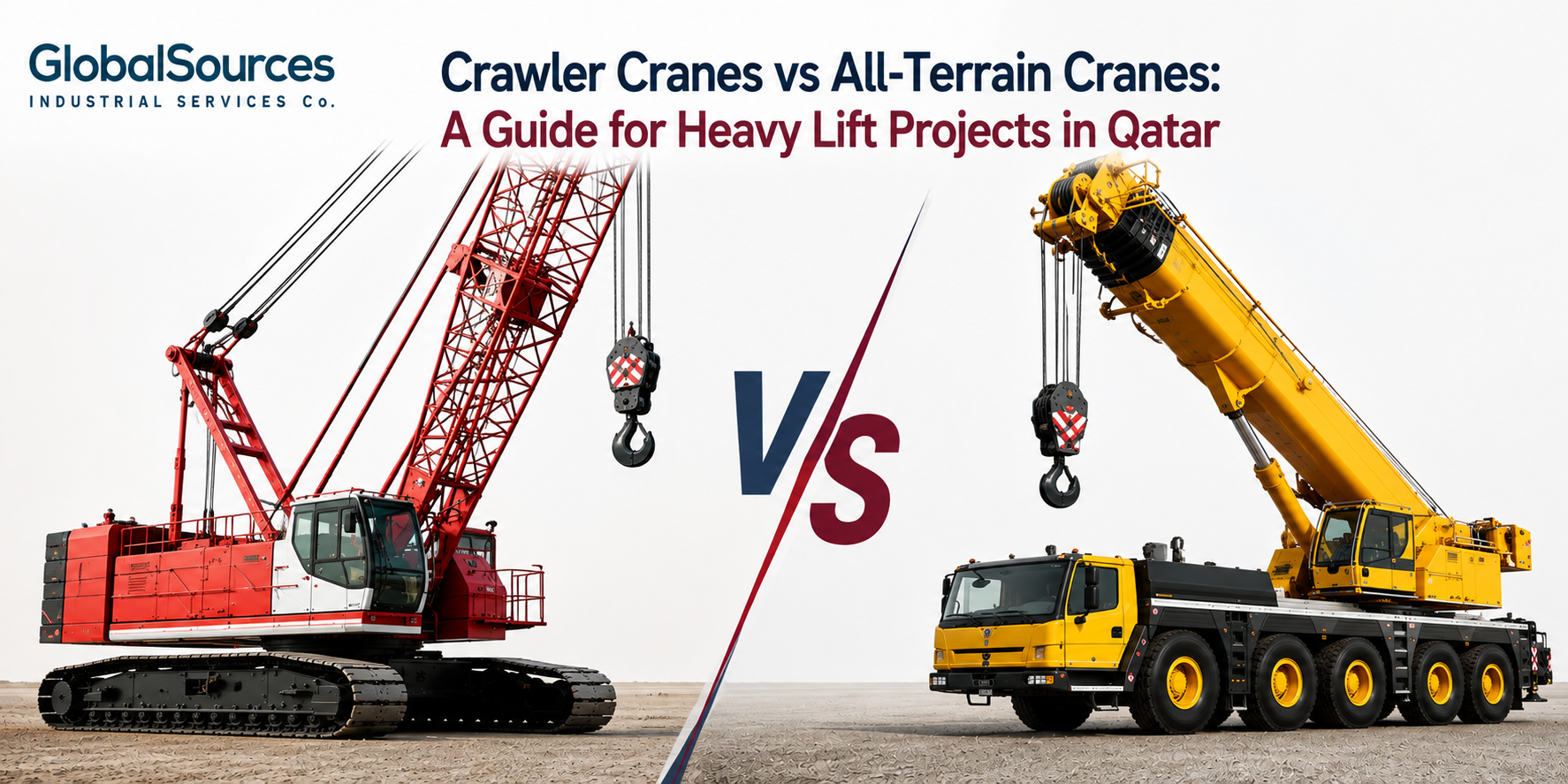
Crawler Cranes vs All-Terrain Cranes: A Guide for Heavy Lift Projects in Qatar

For most general construction lifts in Qatar, an all-terrain crane is the go-to solution. But for the heaviest lifts — LNG plant turnarounds, refinery module installation, and long-duration heavy lifts at Ras Laffan or Mesaieed — a crawler crane is often the only practical choice.

Understanding when a crawler crane makes more sense than an AT crane can save significant cost and planning time on your next major project.

“Crawler cranes don’t travel fast, but they lift heavy and stand firm. For the biggest lifts in Qatar, nothing else comes close.”

What Is a Crawler Crane?

A crawler crane is a lifting machine mounted on two sets of continuous tracks — like a tank — rather than tyres. The tracks distribute the crane’s weight over a very large footprint, allowing it to work on soft or variable ground without outriggers. Crawler cranes are capable of lifting and travelling with a load suspended — something no wheeled crane can safely do. Capacities range from 100 tons to over 3,500 tons for the largest lattice boom crawlers.

Key Differences: Crawler vs All-Terrain


Factor Crawler Crane All-Terrain Crane
Capacity Range 100T – 3,500T+ 50T – 1,200T
Ground Bearing Low — spreads weight over tracks High — requires solid ground or mats
Mobility Cannot travel on roads — requires transport Self-propelled on roads
Mobilisation Complex — disassembled for transport Simple — drives to site
Set-Up Time Hours to days 30–60 minutes
Duration Best for long-term site stays Best for single or short lifts
Load & Carry Can travel with load suspended Cannot


Qatar Use LNG plants, refineries, mega projects General construction, oil & gas

When to Choose a Crawler Crane in Qatar

Choose a crawler crane when your lift exceeds the capacity of available AT cranes, when you need to work on soft or variable ground, when the lift will take multiple days and the crane needs to remain in position, or when the project involves load-and-carry operations — moving a load while the crane is in motion.

In Qatar, crawler cranes are most commonly deployed at Ras Laffan Industrial City for LNG plant turnarounds, module lifts, and maintenance of QatarEnergy facilities; at Mesaieed for refinery and petrochemical projects; and on large infrastructure projects such as bridges and marine structures.

BUDGET NOTE: The biggest cost factor with crawler cranes in Qatar is mobilisation. Disassembling, transporting, and reassembling a large crawler crane typically takes 2–5 days. Build this into your project schedule and budget before committing.
Global Sources Qatar provides crawler cranes from 100T to 700T with certified operators for heavy lift projects at Ras Laffan, Mesaieed, and major Qatar infrastructure sites.
View our full services: globalsources.qa/heavy-light-lifting
Best Industrial Service Provider in Qatar - Global Sources Doha

Do You Want To Talk With Us? So Don't be Late.

Call Us: +974 4468 5501