Chat with Global Sources Qatar on WhatsApp

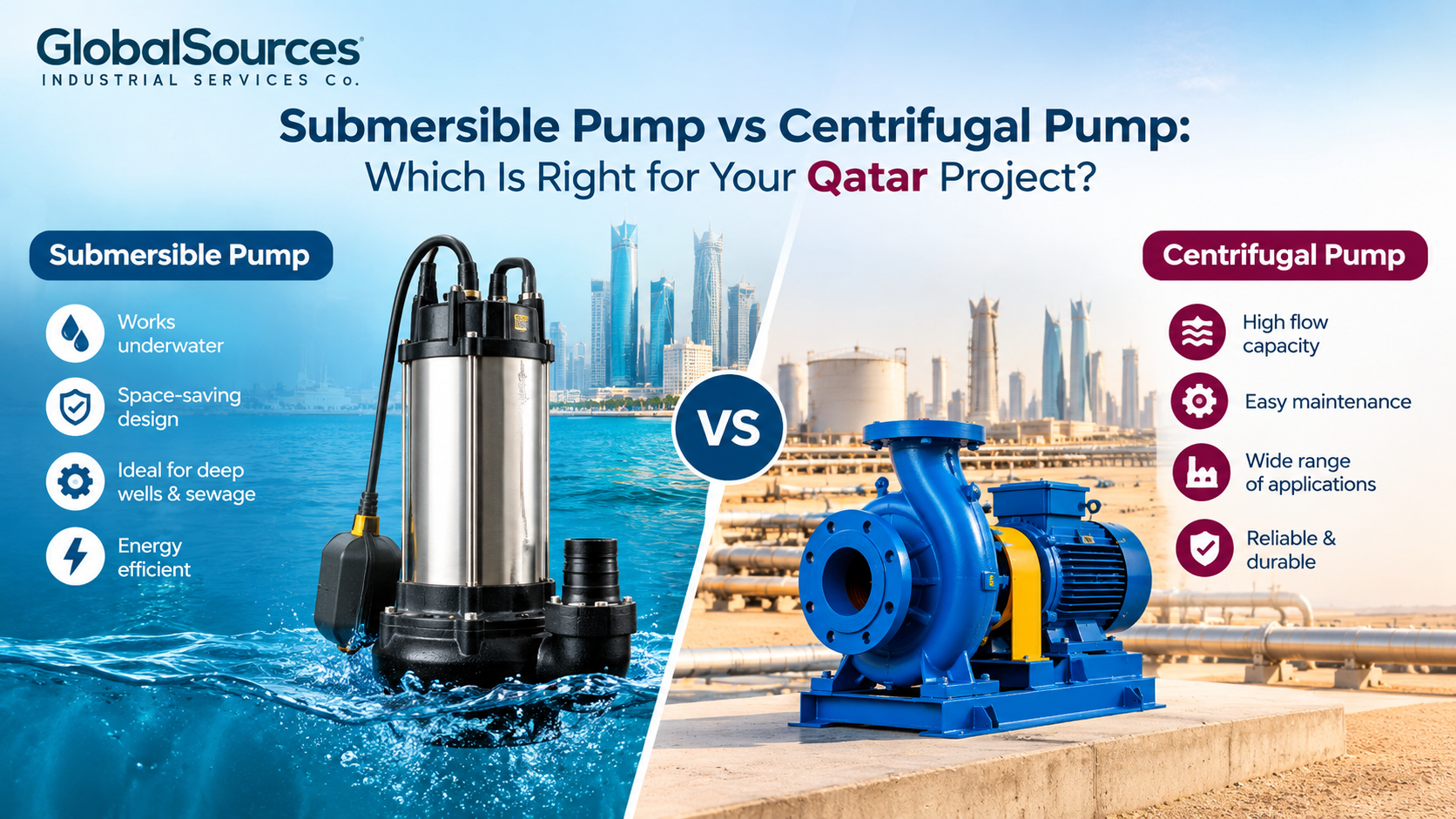
Submersible Pump vs Centrifugal Pump: Which Is Right for Your Qatar Project?

When specifying a pump for construction dewatering in Qatar, the most frequent choice is between a submersible pump and a centrifugal (surface) pump. Both will remove water from an excavation — but they work differently, perform differently in different conditions, and have different strengths and limitations.

This guide explains the key differences and helps you select the right pump type for your Qatar site.

“The best pump for your Qatar site is the one that matches your flow rate requirement, your water quality, and your site conditions — not just the lowest rental price.”

Submersible Pumps — How They Work and When to Use Them

A submersible pump is placed directly in the water — fully submerged — and pumps the water to the surface through a discharge hose. The motor and pump are sealed in a watertight housing. Submersible pumps are self-priming (no need to prime before starting), can handle solids-laden water (sand, silt, debris), and are compact and easy to position in an excavation sump or flooded trench.

Use submersible pumps when: the water is turbid or contains sand and silt, the pump needs to be positioned at the lowest point of the excavation, portability is important, or the site has limited space for surface equipment.

Centrifugal (Surface) Pumps — How They Work and When to Use Them

A centrifugal pump sits on the surface and draws water up from the excavation through a suction hose. It can move much higher volumes of water than a submersible pump of the same size, making it the right choice for high-flow dewatering requirements. Centrifugal pumps require priming before start-up, have a maximum suction lift of around 7–8 metres, and generally cannot handle heavy solids without a strainer.

Use centrifugal pumps when: you need high flow rates, the water is relatively clean, the pump is being used in a permanent or semi-permanent dewatering installation, or you need to move water over a long distance through a discharge pipe.

Direct Comparison

Factor Submersible Pump Centrifugal Pump
Position Submerged in water On the surface above water
Solids Handling Good — handles sand and silt Limited — needs clean water or strainer
Flow Rate Moderate High — better for large volumes
Suction Lift Limit None — fully submerged Max ~7–8m suction lift
Setup Simple — lower into sump Requires priming and setup
Best For Flooded excavations, sludge, high solids High-volume clean water removal
QATAR TIP For most construction dewatering in Qatar’s sandy conditions — where water carries significant sand and silt
— a submersible pump is the safer default choice. Centrifugal pumps used with silty water in Qatar frequently require strainer cleaning and are more prone to blockage.
Global Sources Qatar provides submersible pumps, centrifugal pumps, and complete dewatering systems across Qatar. Our team will recommend the right pump for your site conditions.
View our full services: globalsources.qa/pump-hire-and-dewatering-solutions

How Dewatering Works on Construction Sites in Qatar

Qatar’s coastal geography and shallow water table create dewatering challenges on many construction projects — particularly in Doha, Lusail, and coastal areas where the groundwater level can be very close to the surface. Without effective dewatering, foundation excavations fill with water, trench walls collapse, and concrete pours become impossible.

This guide covers how dewatering works on construction sites in Qatar, what equipment is typically needed, and how site conditions in Qatar affect the dewatering approach.

“In Qatar’s coastal areas, the water table can be within 1–2 metres of the surface. Dewatering is not a reactive measure — it should be in the plan from day one.”

What Is Dewatering and Why Is It Needed?

Dewatering is the controlled removal of groundwater from an excavation to allow safe and productive work below the natural water table. Any excavation that goes below the groundwater level — foundations, basements, pipeline trenches, utility crossings — will fill with water unless it is actively dewatered. In Qatar’s coastal zones and many parts of Doha, the groundwater table can be as shallow as 1.5–3 metres below surface, meaning dewatering is required on the majority of below-grade construction.

Qatar’s Dewatering Challenges

Several factors make dewatering in Qatar more complex than in many other countries. Qatar’s coastal geography means brackish or saline groundwater in many areas — corrosive to pumps and requiring appropriate pump material selection. The sandy, permeable soil in much of Qatar allows groundwater to flow freely into excavations from all sides. During Qatar’s occasional heavy rainfall, surface water can overwhelm drainage systems and add to the dewatering load.

Dewatering Methods Used in Qatar

Method How It Works Best Used When
Open Sump Pumping Water collects in a sump at the lowest point — pumped out continuously Shallow excavations with low water flow
Wellpoint System String of small wells around the excavation connected to a vacuum pump — lowers the water table Medium depth (3–6m), permeable sandy soils — common in Qatar
Deep Well Dewatering Large diameter wells drilled around the excavation with submersible pumps in each Deep excavations (6m+), high water flow, aquifer conditions
Eductor (Jet) Wells High-pressure water system creates suction in small diameter wells Very fine-grained soils where wellpoints underperform

Practical Steps for Dewatering in Qatar

✔ Geotechnical investigation first Confirm depth to water table, soil permeability, and groundwater chemistry before selecting dewatering method
✔ Design the dewatering system Wellpoint spacing, pump capacity, discharge point, and monitoring wells — not guesswork
✔ Install and test before excavation starts Start dewatering 24–48 hours before excavation begins to lower the water table
✔ Monitor continuously during excavation Check water levels in monitoring points throughout — water table conditions can change
✔ Plan the dewatered water discharge Qatar’s municipality requires approval for discharging dewatered groundwater to drainage
Global Sources Qatar provides dewatering pumps, wellpoint systems, and complete dewatering solutions for construction projects across Doha, Lusail, Ras Laffan, and Mesaieed.
View our full services: globalsources.qa/pump-hire-and-dewatering-solutions
Global Sources branded tipper truck in Qatar

Do You Want To Talk With Us? So Don't be Late.

Call Us: +974 4468 5501